

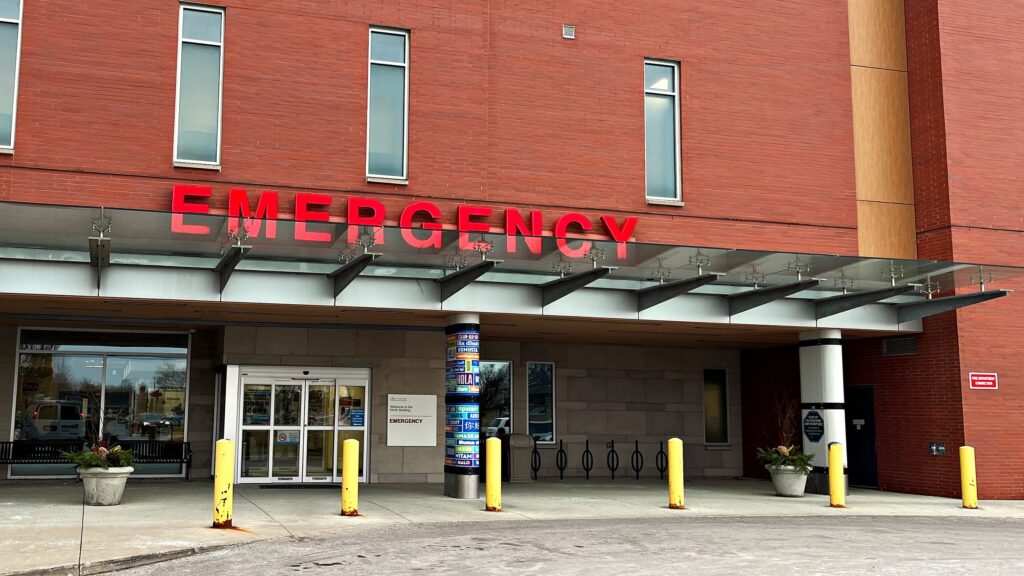
Patients who came to the emergency department at St. Thomas Elgin General Hospital (STEGH) in September and then needed a hospital bed spent an average of 5.2 hours in emergency, according to Ontario Health’s newest monthly figures. Across Ontario, the average for those patients was 19 hours.
That time runs from check-in to the moment the patient leaves emergency for a hospital bed, so it includes tests, results and any wait for a bed to open. The province’s target is 8 hours. At STEGH, 88% of the 606 patients admitted through emergency in September made it within 8 hours. Across Ontario, about 26% did. By LocVox’s own count of Ontario Health’s September figures, only five of the more than 150 Ontario emergency departments with data had a shorter average than STEGH.
In every month from September 2025 to September 2026, admitted patients at STEGH averaged between 4.6 and 5.9 hours in emergency, with the longest months in December 2025 and February 2026 at 5.9 hours each. Across Ontario, the monthly average ran from 16.8 to 20.3 hours.
In September, 1 in 10 admitted patients at STEGH spent more than 8.6 hours in emergency. Across Ontario, 1 in 10 spent more than 39.7 hours, or over a day and a half.
Most people who visit emergency are treated and sent home, and those visits were quicker in St. Thomas too. For high-urgency patients who were treated and sent home, the average stay at STEGH in September was 3.4 hours, against 4.7 hours across Ontario. For low-urgency patients who went home, such as someone with a sore throat or vomiting, it was 2.0 hours, against 3.2 across Ontario. The target for those low-urgency visits is 4 hours, and STEGH met it for 92% of them, compared with 73% across the province.
The first wait, from check-in to being seen by a doctor or nurse practitioner, averaged 1.5 hours at STEGH in September, against 2.0 hours across Ontario. One patient in 10 at STEGH waited longer than 3.3 hours for that first assessment.
Nearby hospitals were slower for admitted patients. In September, the average was 14.1 hours at London Health Sciences Centre’s Victoria Hospital and 19.1 hours at University Hospital. It was 16.7 hours at Strathroy Middlesex General Hospital, 17.1 hours at the Tillsonburg hospital run by Rural Road Health Services, and 6.0 hours at Woodstock Hospital. Ontario’s own guide to the figures notes that large, urban hospitals tend to be busier than small, rural ones because they see more patients, including more urgent-need patients.
STEGH counted 61,572 emergency visits in its 2025-26 fiscal year, from April 2025 to March 2026, or about 5,100 a month. On its emergency department page, the hospital calls itself “one of the best performing hospitals in Ontario for ED wait times.”
These are averages for a whole month, not a live wait, and STEGH does not post a live wait online. Ontario Health’s figures also leave out people who checked in but left before they were seen.
When you arrive, a triage nurse decides how urgent your problem is, and other patients may go in ahead of you if their need is greater. If the problem is urgent but not life-threatening and you cannot get in to your own doctor, STEGH also points to Ontario’s virtual urgent care, run by London Health Sciences Centre and St. Joseph’s Healthcare Hamilton, at UrgentCareOntario.ca or 1-844-227-3844. For a life-threatening emergency, call 911.
Ontario Health posts new figures every month on its emergency department wait times page, where you can look up any hospital in the province. As of November 26th, September is the newest month it has posted.
Sources: Ontario Health: Time Spent in Emergency Departments, STEGH: Emergency Department, STEGH: Facts & Stats 2025-26
By Anthony Zruna · About the LocVox Newsroom

Facebook does not show posts that link to Canadian news sites, so this story is shared as a picture.
- Save the picture.
- Copy the caption.
- Start a Facebook post, add the picture and paste the caption.