

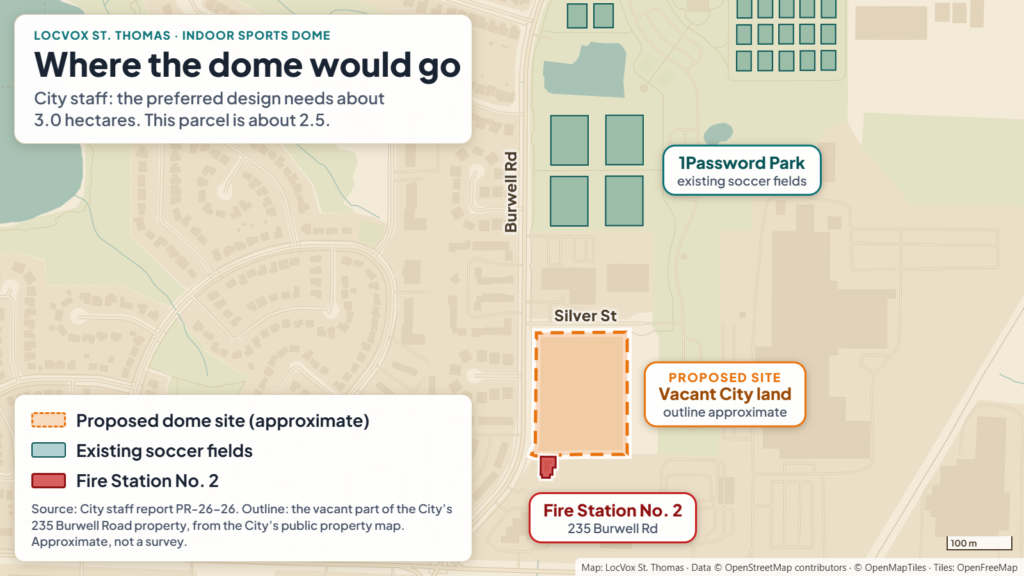
City staff want St. Thomas to ask the province for money to build an indoor sports dome, but the design they prefer needs about 3.0 hectares of land and the site they have in mind is about 2.5. A report going to council at its October 13th meeting calls site size “the primary project risk” and says the vacant City land on Silver Street “may be further constrained by recent property transactions.”
The report, PR-26-26, asks council for two things. The first is to back an application to Ontario’s Community Sport and Recreation Infrastructure Fund, which closes December 22nd. The second is to hire Baker Turner Inc. for an implementation study costing $90,800 plus HST. The study is not in the budget, so the money would come from the City’s infrastructure reserve. The mayor and clerk would be allowed to sign any agreements the application needs.
Where the land is
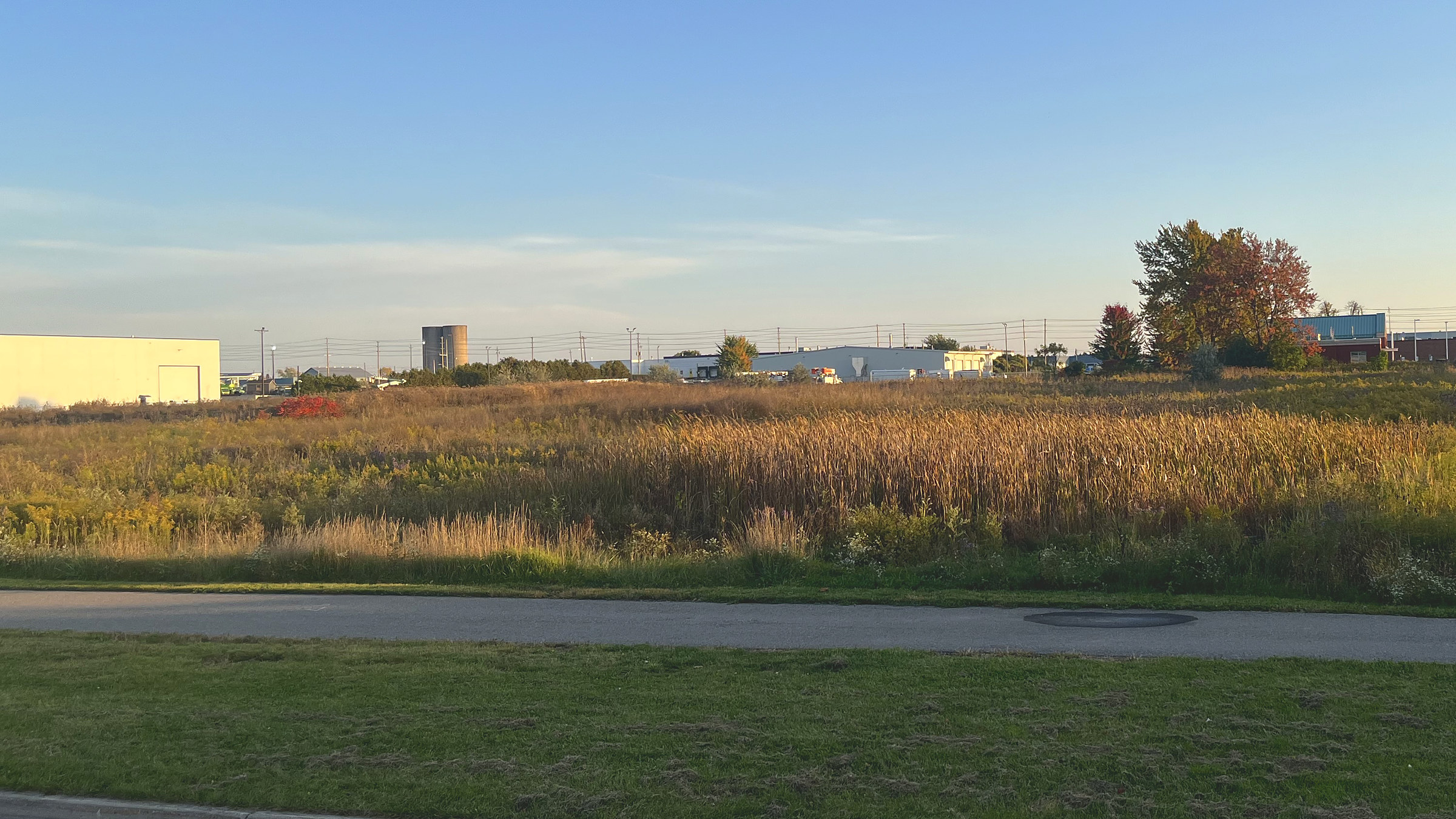
The land sits on the south side of Silver Street, just east of Burwell Road, with Fire Station No. 2 at 235 Burwell Road on its south side. The City’s 2026 feasibility study pointed to it because it is close to the soccer fields at 1Password Park.
Two designs, and the site’s size matters
That feasibility study, dated February 2026, drew up two dome designs “to provide the City with options for further consideration.”
- Concept 2a has two small-sided turf fields and a support building. It would cost about $10.8 million and needs at least 2.5 hectares.
- Concept 2b adds sports courts (2 basketball, 4 volleyball and 6 pickleball), a walking track around the edge and a bigger support building. It would cost about $14 million and needs at least 3.0 hectares.
About the Silver Street land, the study said: “This property meets the minimum size requirement for Sports Dome Concept 2a.” That design needs the whole 2.5 hectares, with nothing to spare. Staff’s report says the study identified Concept 2b, the bigger one, as the preferred design to study further. The report does not say why the bigger design was preferred over the smaller one.
The study also noted that the sports courts “may not be required” if a future Community and Aquatic Centre includes a double gym.
If Concept 2b does not fit, the consultants would look at other layouts, work out whether more land is needed, and recommend a design that fits the site, with new cost estimates. Staff say a smaller design would not necessarily stop the City from applying.
What the City would pay
The $14 million is a Class D estimate. The study calls its figures “Class D budgets (+/- 20%),” in 2025 dollars. On $14 million, 20 per cent either way is about $11.2 million to $16.8 million. The study also suggests raising budgets by at least 5 per cent a year for later years, to cover rising building costs. The dome estimates leave out land, legal costs, environmental cleanup and project management.
The provincial fund pays up to 50 per cent of eligible costs, to a maximum of $10 million. Half of $14 million is $7 million, so the cap would not come into play at today’s estimate. The province says successful applicants “must cover all remaining project expenses,” and they cannot use other provincial funding on the same project.
The report does not put a number on the City’s share or say where it would come from. If the grant comes through, staff would report back on the City’s contribution, a funding plan, and sponsors or partners before anything is built. The study said the City does not have enough money in reserve to build everything it recommends, and that development charges, property taxes, reserves and grants are likely to pay for new facilities.
The $90,800 study itself leaves out land surveys, soil tests, a first-stage environmental review and permit fees.
The profit forecast
The study expects the dome to cover its own running costs. Concept 2b would bring in $770,000 to $940,000 a year and cost $637,000 to $780,000 to run, leaving a profit of about $131,000 to $161,000. The smaller Concept 2a would make almost the same, $126,000 to $159,000.
The same study looked at a separate and much larger project, a community and aquatic centre with pools. It expects even the smaller version of that building to lose $910,000 to $1.1 million a year.
The study shows what that rests on:
- The smaller design would be open about 100 hours a week, with 54 per cent of those hours in “prime time.” The bigger design’s hours would be similar.
- Most of the money would come from renting the turf fields, mostly to soccer clubs. Rental rates and how often fields are booked were set at about the middle of what similar facilities charge and see.
- City staff would run it, led by a dome program coordinator.
The forecast also leaves things out. The profit figures “exclude capital replacement contributions.” The study says the dome’s fabric would need replacing in about 15 to 20 years, and it recommends the City set money aside every year for that and for repairs. It adds that domes “generally have higher operating costs due to utility usage” and can struggle to fill summer and daytime hours.
A tight clock
Staff say the study will take 8 to 10 weeks and “must proceed immediately.” Counted from October 13th, eight weeks ends December 8th. Ten weeks ends December 22nd, the day applications close.
The province does not give a date for its decision. Its program page says only that “all applicants will be notified by email when decisions have been made.” Projects it funds must be finished within 36 months of approval, and no later than March 31st, 2030.
What about the pool?
The dome is one half of the 2026 feasibility study. The other half is a Community and Aquatic Centre. The study’s basic version, with a 25-metre pool, a leisure pool and a double gym, came to about $69.9 million for its first phase.
When council received that study on March 9th, staff wrote that it “does not provide the depth of analysis that staff would regard as sufficient to support implementation at this stage.” On August 10th, council asked staff to report back on alternatives to the Community and Aquatic Centre, using the approach of a similar project in the Town of Uxbridge as a guide.
The October 13th report does not ask for pool money. Staff say they are still looking at other building types, including membrane-supported structures. There is no site for a pool yet, and no City-owned land big enough for one.
What happens next
Staff say applying is not approval to build. Before any design or construction, they would come back to council with the study’s results, the grant decision and options. Any money from the City would need its own council vote.
Sources: Report PR-26-26, Indoor Sports Dome Implementation Study and CSRIF Funding Application · Community and Aquatic Centre Feasibility Study (February 2026) · Ontario CSRIF Stream 2 program page
By Anthony Zruna · About the LocVox Newsroom
Facebook does not show posts that link to Canadian news sites, so this story is shared as a picture.
- Save the picture.
- Copy the caption.
- Start a Facebook post, add the picture and paste the caption.