

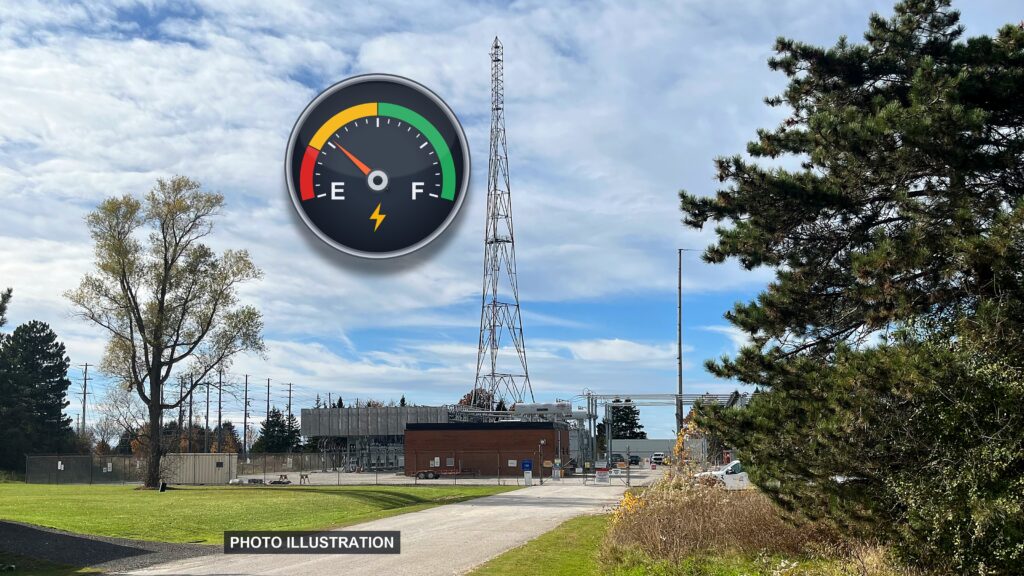
The City has told the province that its land in Yarmouth Yards is shovel-ready, with roads, water and sewer pipes, and stormwater systems already in place. What St. Thomas is running short of, the City and its economic development agency say, is electricity.
The warning comes in formal letters dated October 22nd and 23rd, now posted on the website of the Independent Electricity System Operator (IESO), the provincial agency that plans Ontario’s power grid. The IESO is writing a regional electricity plan for the London area, which includes St. Thomas, and it asked for comments by October 23rd. City council endorsed sending the City’s comments at its October 19th meeting.
The letters focus on the Edgeware Transformer Station, which takes power off two 230-kilovolt transmission lines and steps it down for customers of three local utilities: Entegrus, Hydro One’s own distribution business and London Hydro. “St. Thomas is currently served by a single transformation point,” the St. Thomas Economic Development Corporation (EDC) wrote. The City’s letter, signed by Justin Lawrence, the City’s executive director of industrial development, on behalf of council, says supply from Edgeware “is very limited.”
The EDC puts numbers on it. CEO Sean Dyke wrote that the IESO’s own planning figures, as the EDC reads them, show about 17 megawatts (MW) of room left at Edgeware under long-term contingency rules. That figure, the EDC says, does not yet count an industrial connection agreement of about 9 MW that Entegrus signed in 2026, or other loads waiting in line. “Once those are accounted for, the capacity available to new proponents is in the single digits of megawatts.”
That matters because of who is asking. Over the past 12 months, the EDC says it has fielded serious inquiries from companies needing 5 MW to 120 MW, including advanced manufacturers, energy storage, data centres and existing plants looking to expand. Several are in late-stage site selection, it says. “The pattern we now face is that any single large proponent will be told there is no capacity, and in site selection that answer ends the conversation,” Dyke wrote. Data centres, one of the kinds of company the EDC named, are on hold on the city’s employment lands until September 21st, 2027, under the pause council passed in September.
New homes need power too. The EDC points to the City’s 2024 growth study, which forecasts roughly 7,000 new homes in St. Thomas between 2026 and 2036, and to Central Elgin’s plan for 3,500 homes on the former psychiatric hospital lands on Sunset Drive, which it says is served by the same station. By the EDC’s estimate, those 10,500 homes add up to “on the order of 20 MW” of load, more than the room it says is left at Edgeware before any new industry connects.
The IESO’s own planning slides, shown at an October 2nd webinar, point the same way. Under the IESO’s reference forecast, demand at the Edgeware station outgrows the load it is rated to carry in 2027; only its slow-growth forecast pushes that back to 2039. That rating has a safety margin built in: the station has to be able to carry all its customers if one of its transformers fails. The two lines that bring power to the station from London follow the same kind of safety redundancy rule, and they are expected to reach the limit that rule sets in 2027 under all three growth forecasts. The slides also say new transmission “is expected to take at least 5-7 years” to build.
PowerCo, Volkswagen’s battery plant, has its own supply on the way. Hydro One is building the St. Thomas Line, a 230-kilovolt line about 20 kilometres long, from an existing line north of Highway 401 in London to the new Centennial Transformer Station in St. Thomas, to connect the plant. Hydro One plans to connect and energize it in the summer or fall of 2027, and says its timelines are subject to change.
The City sees that new line as a possible stopgap. Its letter suggests looking at using some of the capacity built for the plant, which it calls “deemed customer owned,” by turning it into shared grid equipment, and notes that this would need the private customers to agree. Alongside that stopgap, the City backs a new 230-kilovolt transformer station “in the short term,” new 230 kV and 500 kV line capacity, and a new 500 kV station, which it calls “the best ultimate solution.” The EDC asks the IESO to name the new 230 kV station as a need within two years. The City also says it can make large parcels of land available quickly for new hydro equipment.
Entegrus, the local power distributor, told council on October 19th that it already sees the squeeze. President and CEO Tomo Matesic said capacity on the city’s M13 feeder, supplied from Edgeware, “is quickly being utilized,” and that Entegrus is working with the IESO and Hydro One on a new station “which is being proposed in the next three to five year timeline.” Entegrus’s presentation that night said it had spent $1.6 million on a new breaker at Edgeware to add 25% to the community’s electrical supply.
As for who pays, the IESO’s slides say a company pays for equipment that serves only its own connection, while the cost of shared lines and stations is spread across all ratepayers. As LocVox reported in September, a separate provincial study already points to a new 500/230 kV station in the St. Thomas area around the late 2030s, and this London-area plan is what will set its timing.
The IESO plans to present its options and draft recommendations in the first three months of 2027, at a municipal meeting and a public webinar. The final plan is scheduled for the second quarter of 2027, though the IESO’s own timeline notes a six-month extension is expected. If the plan calls for new lines or stations, Hydro One would then lead the detailed planning for how to build them.
Sources: City of St. Thomas and St. Thomas EDC submissions to the IESO (October 2026) · IESO London Area needs and options presentation (October 2nd, 2026) · Hydro One St. Thomas Line project · Hydro One London Area Needs Assessment (November 2024)
By Anthony Zruna · About the LocVox Newsroom
Facebook does not show posts that link to Canadian news sites, so this story is shared as a picture.
- Save the picture.
- Copy the caption.
- Start a Facebook post, add the picture and paste the caption.