

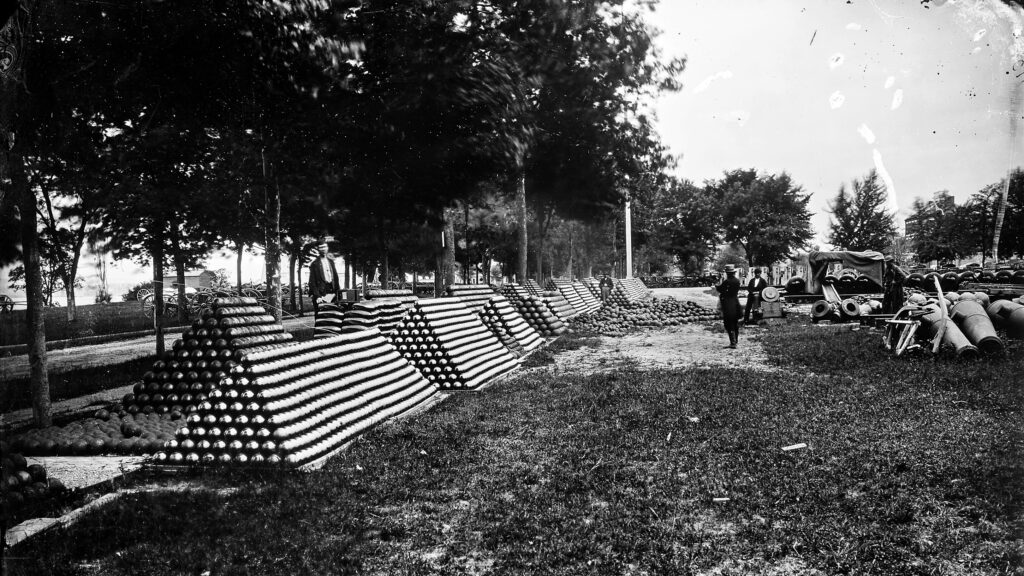
Cannon balls stacked in long rows around the time of the American Civil War, about 1860 to 1865, in a photo from Mathew Brady’s studio. These are not the cannon balls in this story, but they show what a big stock of them looked like. Photo: Brady National Photographic Art Gallery, about 1860-1865. U.S. National Archives (111-B-3946). Public domain.
As Elijah Leonard told it in a memoir published in 1894, three years after his death, one of his closest friends reported him to a magistrate for keeping cannon balls. Leonard was a young American who ran an iron foundry in St. Thomas, a shop where iron is melted and poured into moulds. He was melting them down, he wrote. He made plow points, the iron tips of plows that cut the soil and wear out.
He had gone into business here in 1834, at 19. His first shop was an abandoned axe factory that he rented near Anson Paul’s mill, south of the village in the Kettle Creek valley, in a spot called Hog Hollow. About 1835 or 1836, he built a shop on the east side of Port Stanley Street, today’s Stanley Street, near the Centre Street corner.
In December 1837, reformers in Upper Canada took up arms against the colonial government. The rising failed within days, but invasion scares from the American side went on through 1838. Americans in St. Thomas were watched with suspicion, and Leonard was one of them. By his own account, he was arrested four times “on trivial charges,” on complaints from St. Thomas people who had known him for three or four years. He described two of the arrests. One was for being on the street after curfew.
The other was over the cannon balls. By Leonard’s account, his friend took the complaint to Squire Ermatinger, and a Squire Crysler was among the magistrates who heard it. “Squire” was what people called a magistrate, a local justice of the peace. Both names are on a list of the district’s magistrates from 1833, a few years before the hearing: an Edward Ermatinger and a J. Crysler.
Leonard wrote that he told the magistrates he had bought a boatload of the cannon balls from a Captain Malloy. Malloy, he said, had bought them at Amherstburg from army stores written off as unfit for use, left over from the War of 1812.
Leonard wrote that he overheard Squire Crysler say: “Let the boy off. There is nothing in the charge. He is only fulfilling the Scripture by ‘beating swords into pruning hooks’ or ‘cannon balls into plow points!'” He was let go, he wrote, and he never forgave his friend. His memoir never names him. No record of the arrests from the time has been found. They rest on his word.
By the end of the 1830s, Leonard had moved to London. He wrote that he had been struggling to get a footing here, and that London was booming, with army barracks going up. His brothers Lyman and Delos ran the St. Thomas foundry until 1842. Then John Sells became his partner, until Sells bought Leonard’s share in April 1851.
In 1862 Leonard, by then a London manufacturer, ran for the Legislative Council, the upper house of the colony’s parliament. His district stretched from London through Elgin County, so the race brought him back to St. Thomas. His campaign complained that opponents were still saying “he is disloyal.”
By Leonard’s account, his rival, the lawyer H. C. R. Becher, told a crowd at a cattle fair in Belmont that Leonard “made plow points for a living.” Leonard shouted back that the issue should be “Law Points vs. Plow Points.” After that, he wrote, he was called the “Plow Point Candidate.” He won by just over 200 votes.
On the day the 1862 result was declared, he wrote, his St. Thomas friends paraded the town behind a band. On top of the pole carrying the Union Jack, he was told, was a plow point he had made years before in his little foundry in Hog Hollow. In 1867 he was named to the Senate.
About 1870, the old Stanley Street shop was taken down to make way for the Canada Southern Railway. Nothing of the foundry remains. Walk south on Stanley Street from Talbot Street, with the Foodland on your left. Just before Centre Street, you cross the route of the old Canada Southern line. Leonard’s shop stood on your left, the east side, where the line later crossed.
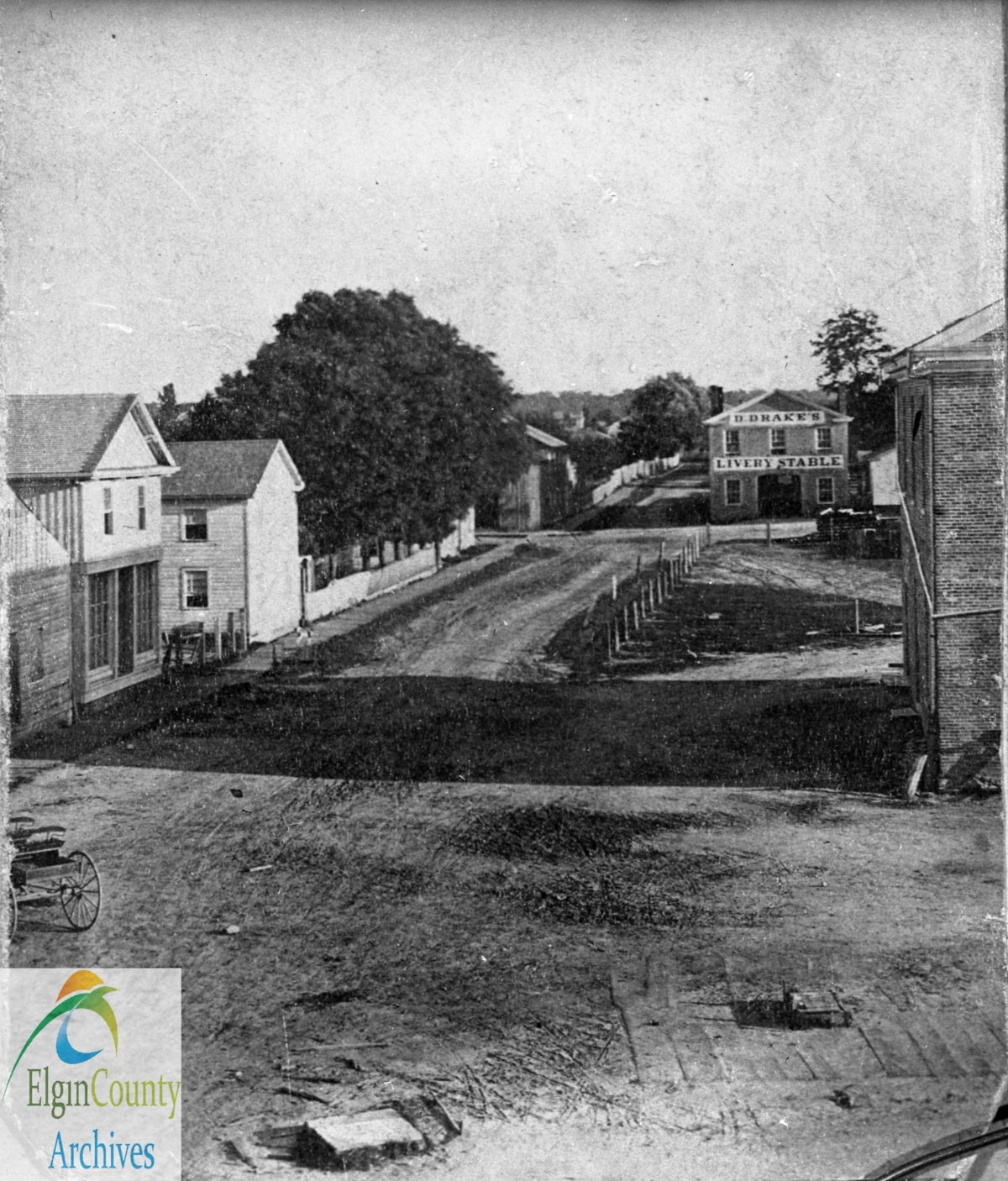
Sources: The Honorable Elijah Leonard: A Memoir (London, Ont.: Advertiser Printing Co., 1894), pp. 8-14, 37-38, 42, 46 · Christopher Andreae, “Leonard, Elijah (1814-91),” Dictionary of Canadian Biography, vol. 12 · C. O. Ermatinger, The Talbot Regime (1904), pp. 177, 225-226, 376-377 · History of the County of Middlesex (1889), p. 885 · The Canadian Biographical Dictionary, Ontario Volume (1880), pp. 594-595 · “The two candidates, Leonard vs. Becher” (1862) · The Canadian Parliamentary Companion (1864), p. 21 · St. Thomas Watchman, February 8th, 1851 · W. H. Smith, Canada: Past, Present and Future (1851) · St. Thomas Daily Times, May 15th, 1891 (Elgin County Archives) · Elgin County Archives, Ian D. Cameron Collection, C-3, “Stanley Street, St. Thomas, looking south from Talbot Street”
Facebook does not show posts that link to Canadian news sites, so this story is shared as a picture.
- Save the picture.
- Copy the caption.
- Start a Facebook post, add the picture and paste the caption.