


St. Thomas’s new city council holds its first meeting on Monday, November 16th, at 5 p.m. at City Hall. Mayor Jeff Kohler and eight councillors will make their declarations of office for a four-year term that began November 15th and runs to November 14th, 2030.
Five of the nine members served on the last council. Kohler, a councillor last term, moves to the mayor’s chair. Steve Wookey, Lori Baldwin-Sands, Gary Clarke and Rose Gibson return as councillors. Four councillors are new to this council: Mike Brisson, Kyle Yates, Joe Docherty Jr. and Heather Jackson, a former St. Thomas mayor. Jim Herbert, Earl Taylor and Joan Rymal were not re-elected, as LocVox reported the morning after the October 26th vote.
The first meeting is mostly ceremony. The agenda has council entering the chambers behind Kohler and Piper Rob Angus. The City Clerk then declares the election results, Kohler makes his declaration of office and oath of allegiance and receives the Chain of Office, and the councillors take theirs together. Kohler’s inaugural address follows, and the last item of business is a motion to appoint the City’s signing officers. You can watch in person from the public gallery on Level 4, using the northeast doors from the City Hall parking lot, or join on Zoom through the link on the City’s Council Meetings page.
The mayor, not council, proposes the 2027 budget, because St. Thomas is one of the Ontario municipalities with “strong mayor” powers. Provincial rules say the mayor must propose a budget by February 1st each year. Because 2026 was an election year, the mayor can only propose the 2027 budget in 2027 itself, so any budget the mayor proposes must come between January 1st and February 1st. If the mayor does not propose one by February 1st, council must prepare and adopt the budget itself.
Once the mayor proposes the budget, council has 30 days to change it. The mayor can veto council’s changes, and council can override a veto if two-thirds of its members vote to do so. If council makes no changes in time, the mayor’s budget is adopted. As of November 16th, the City’s budget page lists no 2027 budget dates.
The 2026 budget raised the City’s tax rate by 6.1%. When staff tabled the draft budget in December 2025, they estimated the increase at about $16 a month on the City’s part of the tax bill for a median home assessed at $205,000. The final 2026 property tax levy, the total the City raises for its own spending through property taxes, is $80,154,392.
The City has also ended two years in a row, 2024 and 2025, with an operating deficit. The City’s final 2025 results for day-to-day spending paid by property taxes show a deficit of $748,675, which council covered from the City’s Infrastructure Reserve. That reserve is the City’s main tax-supported fund for capital projects like roads and buildings. In July, staff forecast a deficit of about $500,000 for 2026, mostly from winter road costs, fuel costs in the City’s transit and waste contracts, and fire department overtime. In the same July report, staff said the Infrastructure Reserve was “overcommitted” and projected to go below zero, needing temporary borrowing from other reserves to pay for capital projects already approved.
On November 10th, the St. Thomas Police Services Board approved a revised 2027 operating budget of $23,878,787, a 10.4% increase over 2026. The City’s 2026 budget gave police $21,628,762. Under provincial law, council cannot approve or reject single lines in the police budget. It can only approve or adjust the total.
The last council also sent several decisions on to the 2027 budget. Those include what to do about the Emslie Field grandstand, a $30,000 to $40,000 study on adding long-term care beds at or beyond Valleyview, and how the City should enforce its five-hour parking limit. The City Treasurer also told council in October that the City’s accounting software reaches the end of its life in 2028 and that a 2027 budget request would be made to replace it. LocVox covered the grandstand and Valleyview decisions earlier this month.
The new council also has to fill seats on local boards and committees. Councillors who sit on boards such as the Police Services Board and the Public Library Board can be named early, because those seats do not need public applications. The City plans to advertise the public seats on its committees starting in mid-November for about a month, and the new council could take up those appointments in early 2027. Until then, the public members already serving stay on.
Council holds an orientation session on Tuesday, November 17th, at 5 p.m. The agenda has council voting on a resolution to close that session to the public, because it is for “educating and training members of Council.” Two more orientation sessions are on the City’s calendar for November 23rd and 24th, and regular council meetings are listed for December 7th and December 14th.
Sources: Inaugural meeting agenda, November 16, 2026 · Ontario Regulation 530/22 (strong mayor powers) · Report TR-18-26, 2026 mid-year budget monitoring
By Anthony Zruna · About the LocVox Newsroom
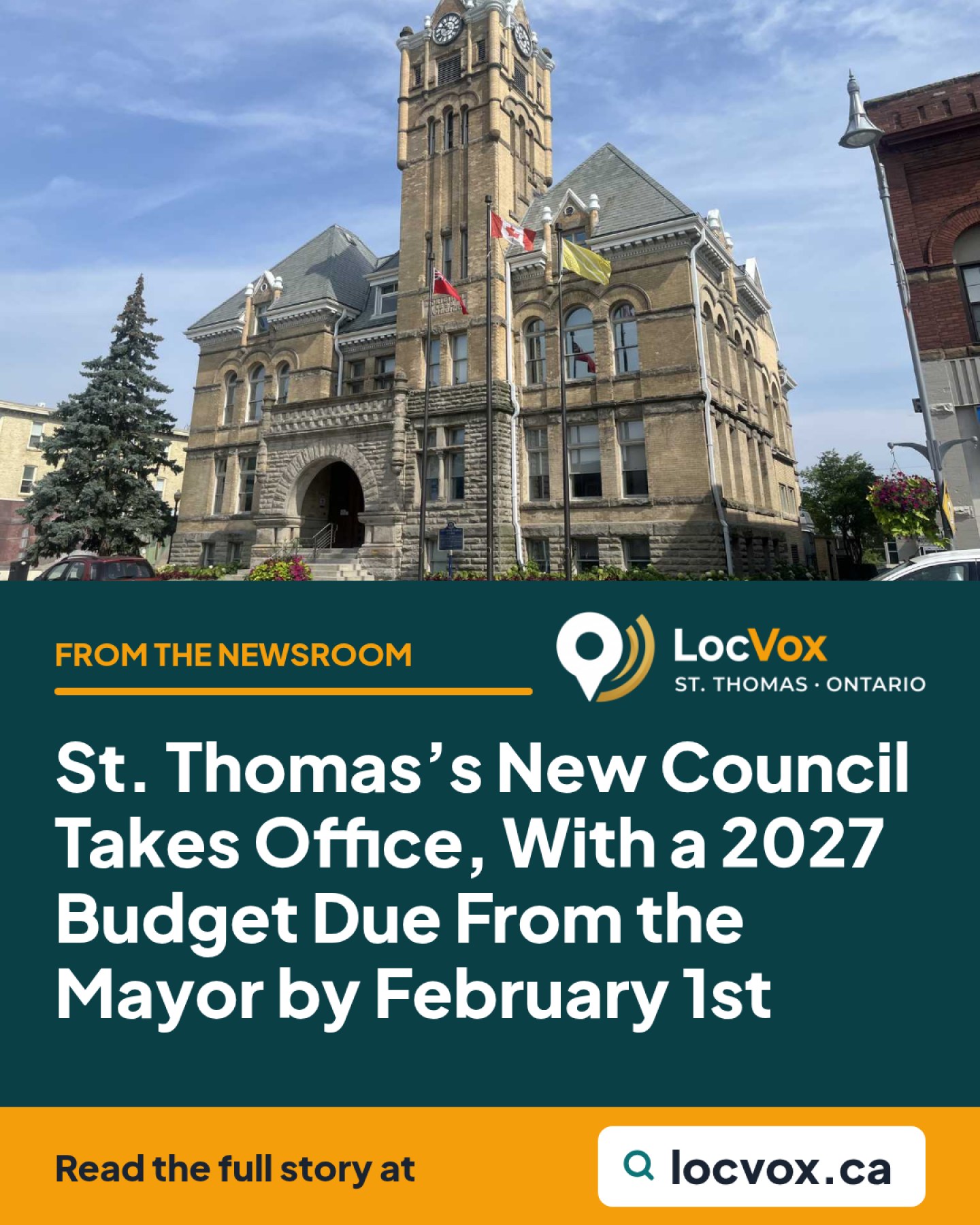
Facebook does not show posts that link to Canadian news sites, so this story is shared as a picture.
- Save the picture.
- Copy the caption.
- Start a Facebook post, add the picture and paste the caption.