

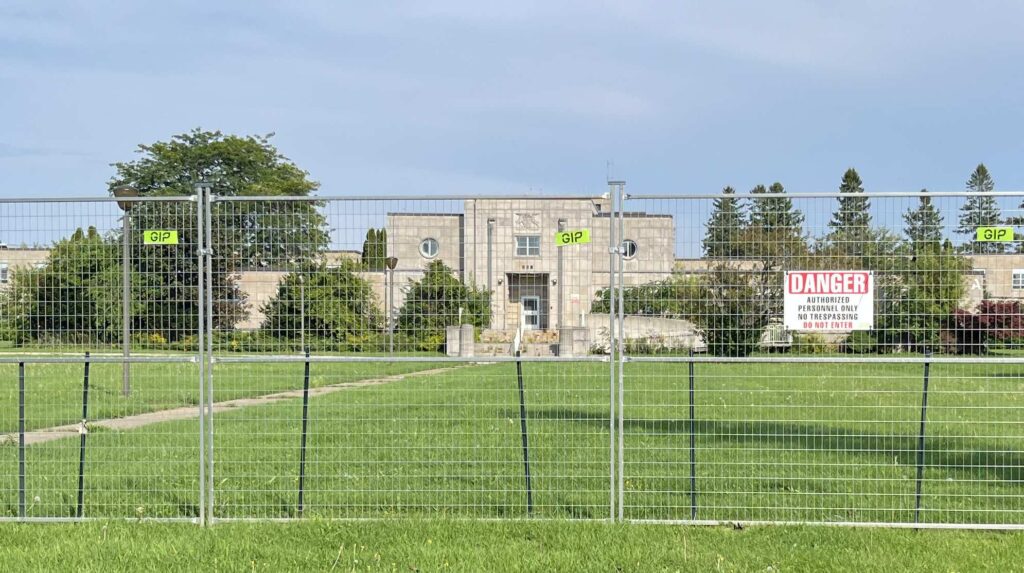
Demolition fencing has ringed part of the old St. Thomas Psychiatric Hospital lands since mid-July, and a $71 million provincial plan to tear down 22 of its historic buildings is under way. Earlier this week, posts about the hospital’s fate in a local Facebook group drew hundreds of comments and dozens of shares in a couple of days, most of it following one resident’s repeated posts pushing to preserve its Art Deco stonework and sculpture.
So is anyone actually planning to save any of it? The answer is yes, at least in part, though the details are still being worked out.
Infrastructure Ontario, the provincial agency that owns the buildings, began preparing the site this spring and has since hired Green Infrastructure Partners of Markham as general contractor. The province says the full process, from site clearing through demolition, will take about two years. The work covers roughly 40 acres of the property, where most of the 22 buildings stand. “Things are moving rapidly,” Central Elgin Mayor Andrew Sloan told CTV News in August.
Central Elgin’s Official Plan Amendment covers a separate area of roughly 370 acres of the old hospital lands for a new mixed-use neighbourhood. Council approved the amendment on April 13th, and Elgin County gave the final sign-off on July 14th. The vision is about 3,500 homes and 9,000 residents, plus a commercial main street, parks, schools and community facilities, timed to housing demand expected once the nearby PowerCo Volkswagen battery plant opens in 2027. The municipality put the land out to developers in March, the call for proposals closed May 4th, and as of early August, no developer has been chosen; the municipality says it’s still reviewing bids and expects to finish “over the next few months.”
The hospital may be a St. Thomas landmark, but the land sits in Central Elgin, so approvals run through Central Elgin council, not St. Thomas’s. And even Central Elgin’s own heritage rules have limited reach here. The complex was recognized as a heritage resource in 2007, and in April 2019 Central Elgin council passed a by-law designating nine of the hospital’s buildings as having cultural heritage value under the Ontario Heritage Act. But the buildings are Crown-owned, and provincially owned heritage properties generally aren’t bound by municipal designation the way private property is; the province instead uses its own Standards and Guidelines for Conservation of Provincial Heritage Properties. CTV News has reported that the province exempted this site from those standards in December 2023, to advance provincial priorities that may include housing and development outcomes. Infrastructure Ontario’s letter proposing demolition reached Central Elgin in April of this year.
So what might actually be saved? Central Elgin’s own project page says Infrastructure Ontario’s contractor “will salvage selected stone carvings and stone elements from the existing buildings,” and that IO has already completed a LiDAR scan to produce an accurate 3D model of the buildings before they come down. Under the RFP’s terms, whichever developer Central Elgin eventually chooses must fold that scan and the salvaged stonework into a commemoration strategy. Mayor Sloan told CTV News in August that the municipality “is also proceeding with a commemorative strategy to recognize the heritage elements on the site,” with more detail expected in the coming months. Historian and preservationist Jennifer Grainger, who has pushed to keep more of the buildings standing, told CBC News in April she’d still like to see at least the exteriors saved, and floated ideas like converting sections into offices, affordable housing or a museum about the history of psychiatric treatment.
That history is part of what made the buildings worth the fight in the first place. Central Elgin’s own heritage by-law says the complex was built between 1937 and 1939 through a collaboration between architect William Lyon Somerville, provincial highways minister T.B. McQuesten and premier Mitchell Hepburn, the same trio behind projects like the QEW. Its stepped facades, chevrons, porthole windows and terrazzo interiors are textbook Art Deco, built from Queenston limestone with what the by-law calls “an important series of bas-relief sculptures” worked into the stone. Grainger has said that sculpture was the work of Jacobine Jones, who went on to head the sculpture department at the Ontario College of Art. Born in England as Phyllis Jacobine Jones, she worked and signed simply as Jacobine Jones. During the war, the federal Department of National Defence used the grounds as a flight training centre before the site reverted to psychiatric care. St. Joseph’s Health Care London ran the hospital from 2001 until it closed for good in 2013; the designated buildings have sat vacant ever since.
One idea already circulating: work salvaged pieces into public art, the way the city has done elsewhere. The roundabout at Highbury Avenue and Ron McNeil Line carries a commissioned sculpture, Fading Memories, and the city commissioned a companion piece for a second roundabout nearby. Whether anything from the old hospital ends up somewhere similar is still an open question. For now, the clearest answer on record is Infrastructure Ontario’s own: selected stonework is meant to survive, even though the buildings around it will not.
Sources: CBC News, “St. Thomas’ Psychiatric Hospital land will be converted to 3,500 homes”, CTV News London, “We’re moving forward: Demolition fencing up at former psychiatric hospital”, Central Elgin, Hospital Lands Redevelopment project page
By Anthony Zruna · About the LocVox Newsroom