


People who have weighed in on the future of St. Thomas’s Railway Lands keep coming back to one idea: a real central park.
The City’s summary of the second phase of its Railway Lands master plan, posted last week, says there was “strong interest in significant public open space, particularly a central park and connected green space.” Several people wanted the middle of the lands kept “largely open,” with more homes concentrated around the edges. Some worried that towers could “visually and physically isolate a central park space.”
That feedback came from a fairly small group: about 80 people at the City’s August 26th open house, plus 20 feedback forms, 5 emails and 4 comments on its online map. Council agrees with them. At its September 14th meeting, members backed “increased active parkland.”
No plan is final yet. Here is what the City’s own numbers show, and where residents still get a say.
The parkland numbers
When developers build homes, Ontario’s Planning Act lets the City ask them for parkland in return. The more homes, the more parkland they owe. They can hand over land, or pay cash instead.
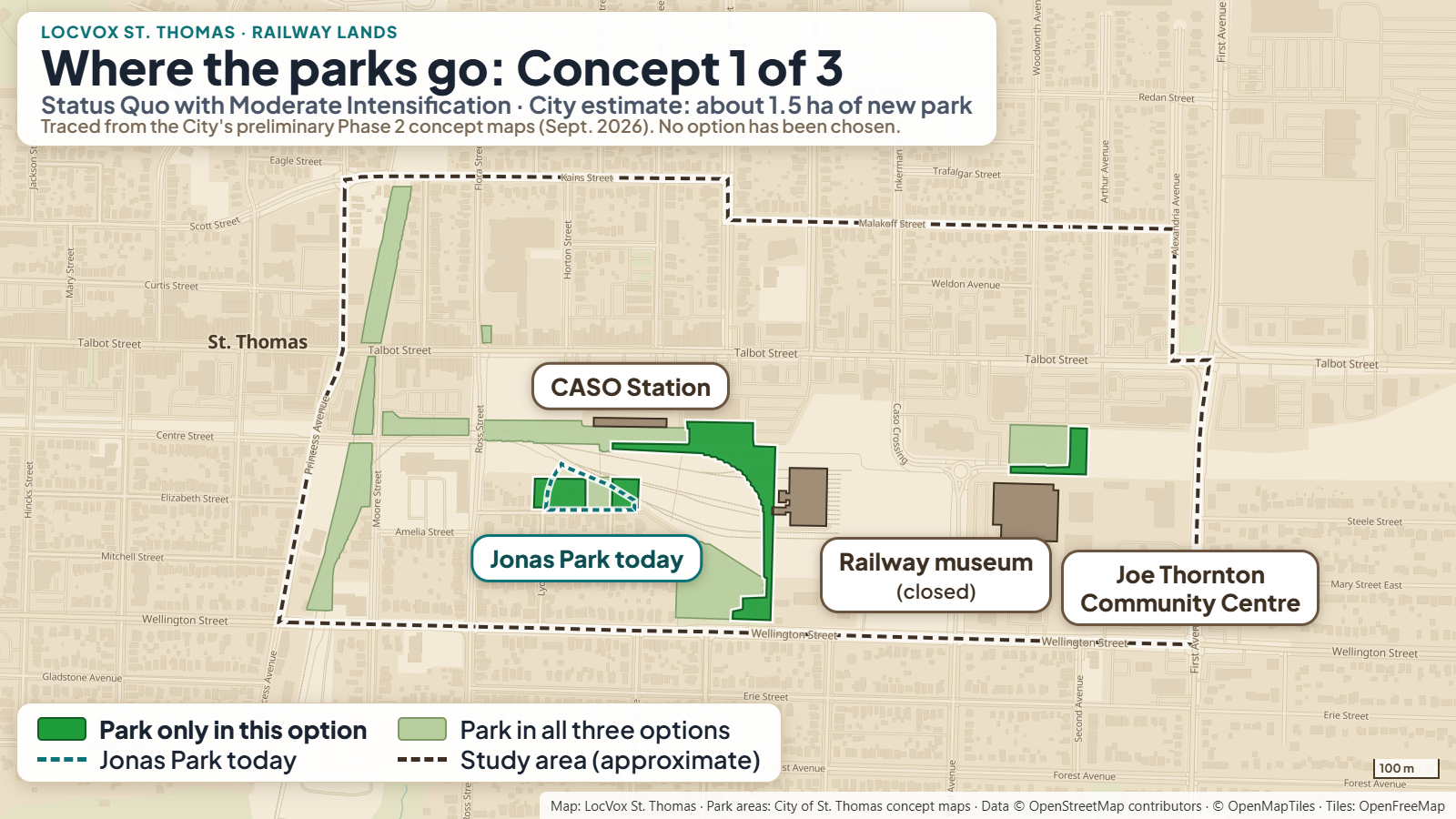
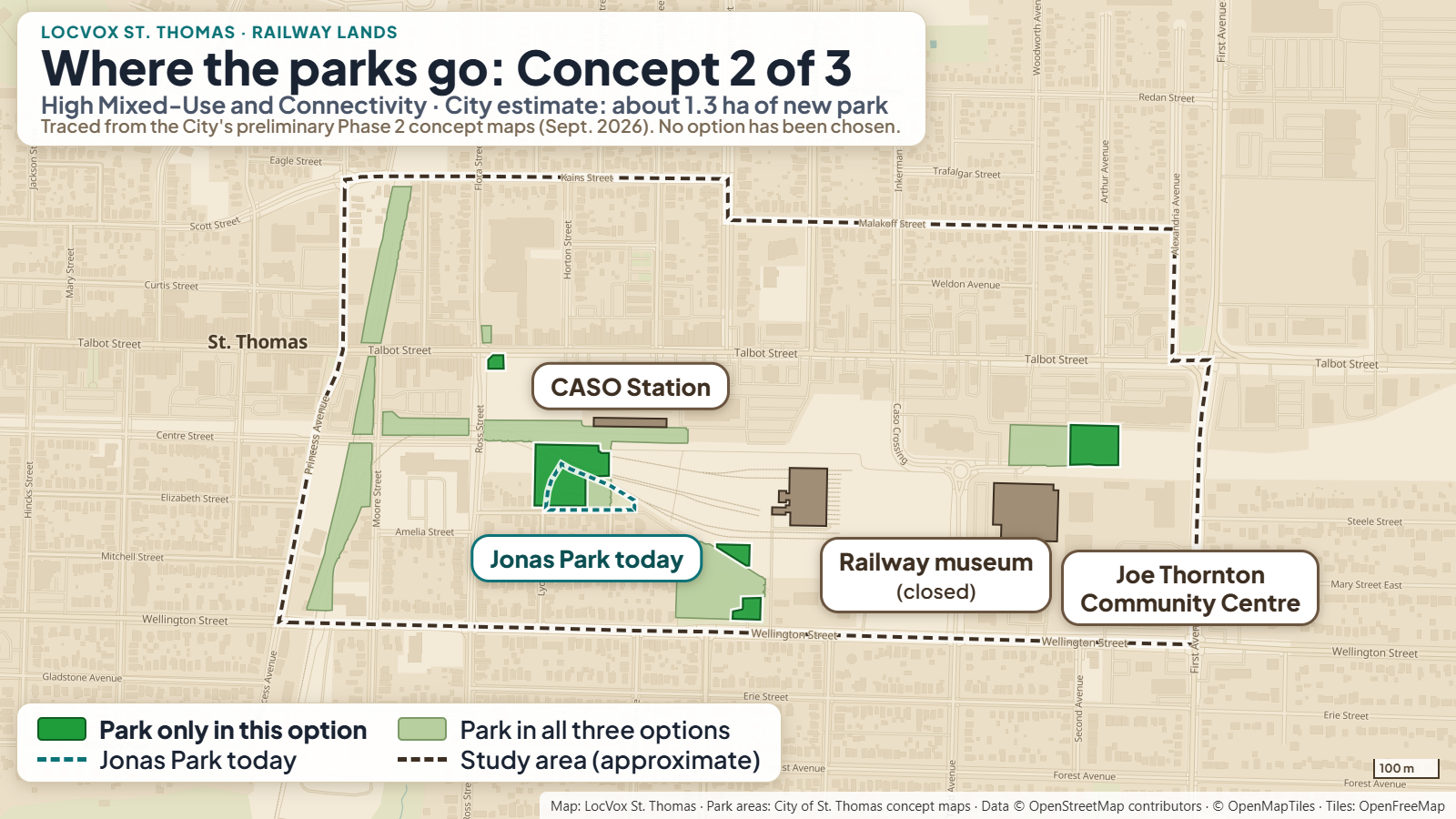
The City worked out how much parkland each option’s new homes would owe, and how much new park each option actually draws on its map:
Concept 1: owes 0.75 to 2.2 hectares. Its map shows about 1.5.
Concept 2: owes 3.8 to 5.9 hectares. Its map shows about 1.3.
Concept 3: owes 4.3 to 5.8 hectares. Its map shows about 2.
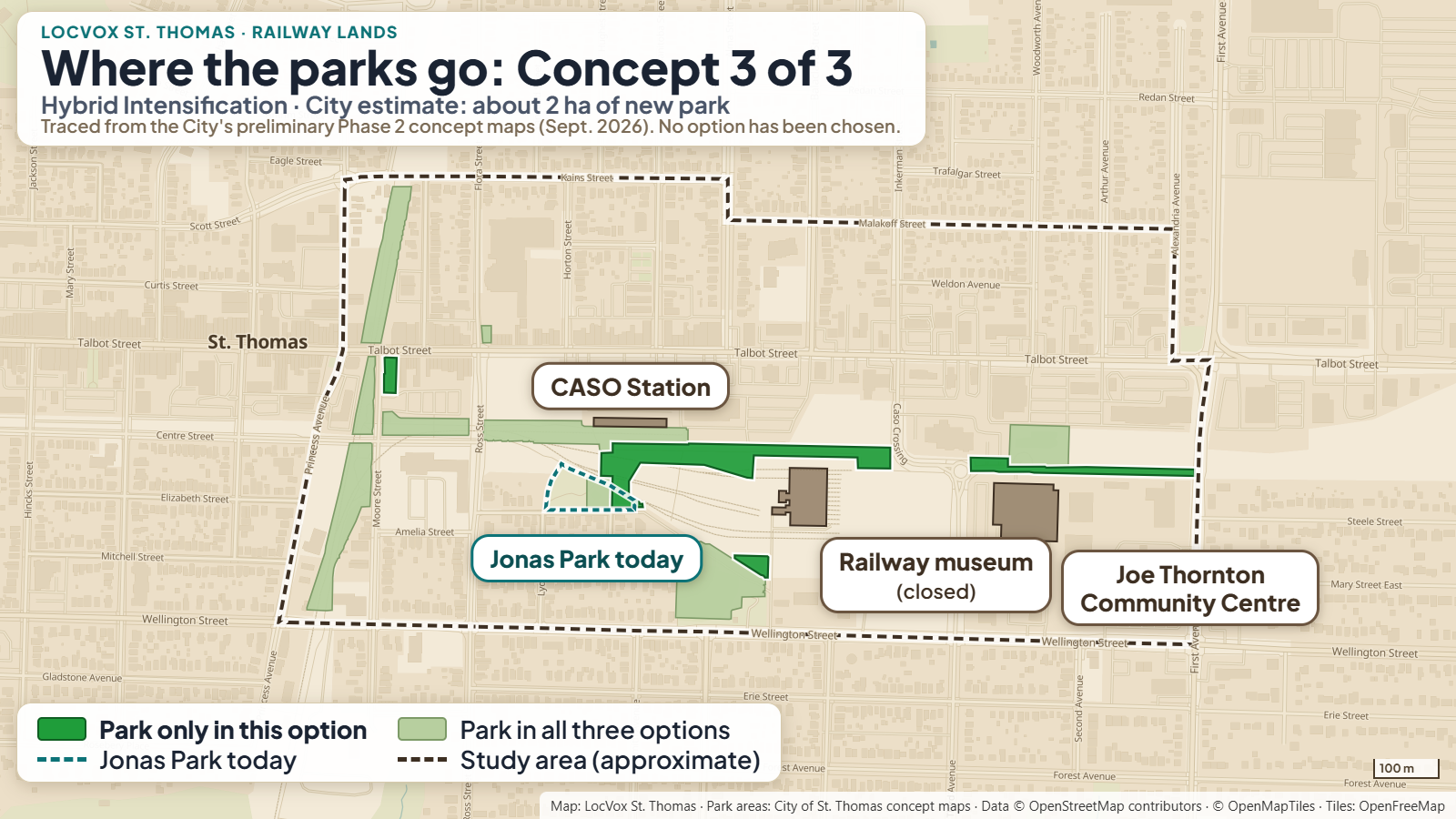
Concept 1 draws about as much park as it owes. Concepts 2 and 3, which add the most homes, draw less than half.
Owing parkland does not mean the park has to be built there. A developer can pay cash instead of handing over land, and the draft maps set aside only part of what’s owed as actual park. Unless the final plan adds more, the rest would likely come as cash, which the City can spend on parks anywhere in St. Thomas. A hectare is about two and a half acres.
The City’s own review of Concept 2 calls it “not a great scenario for amount of new park / new population potential.”
A first report card
The summary also adds the City’s first side-by-side rating of the three options, on six measures. The August open house boards had no such comparison. Each option’s board left its “Overall Evaluation” box empty.
No option comes out on top everywhere. Concept 1, which adds the fewest people, rates best on strain on water and sewer systems but low on most other measures. Concept 2 rates high on meeting the City’s growth plans and on housing, but low on servicing, since it adds the most people for the water and sewer systems to carry. Concept 3 has no low ratings and rates highest on the environment. On community facilities, the measure that includes parks, no option rates better than “medium.”
The City says the chart is “not intended to be a rigid quantitative measurement.” Its summary also notes that the preferred concept “may incorporate elements from different concepts.”
The 2024 land deal
Part of the Railway Lands story is a 2024 land deal. In February 2024, council declared parts of Jonas Park surplus and agreed to sell them to Doug Tarry Limited without a public bid. Staff said the builder needed part of the park for road access from Centre Street and for rail access. This September, council minutes described Doug Tarry Developments as “a major landowner in the study area” that has helped pay for the study.
That does not rule out a park. The master plan will set where parks go, and parkland dedication brings in land or cash as the area develops.
Staff told council in 2024 that the deal came with commitments from the developer. These included “restoration of the rail connection and transfer of access right to the Elgin County Railway Museum,” an extension of Centre Street to CASO Crossing, and “restoration of Jonas Park.”
It matters for the museum, which is currently closed. A key concern in the new feedback was that the options did not “adequately demonstrate how the museum and active railway operations would be accommodated.” As LocVox reported last week, the museum is rallying support to save its 1913 home. The City has said it “cannot provide direct financial support for repairs to a privately owned facility.”
Where your say counts now
This round of feedback is over. When LocVox covered the three options on September 9th, the City’s feedback tools were open. The project page now lists them under “Past Engagement Opportunities.” Here is what comes next:
- Tuesday, October 13th: a public meeting on a draft parkland dedication by-law. Once council passes it, it will set how much land, or cash, new development across the city must give for parks. On September 14th, councillors asked whether a higher percentage was possible. For densely built projects, the Planning Act allows a different measure, one hectare of parkland for every 600 new homes, and City staff want the option to use it.
- November: a second open house, where the City expects to show a draft preferred plan. Staff are aiming for a report to council on the plan in late December.
- Early 2027: a formal public meeting, as the plan moves into the Official Plan and zoning rules.
You can press “Follow” on the City’s Speak Up St. Thomas Railway Lands page to get updates.
Sources: Phase 2: Concepts Summary Document (City of St. Thomas, September 2026) · Council minutes, September 14, 2026 · Council minutes, February 20, 2024 · Planning Act, section 42 (parkland and cash-in-lieu)
By Anthony Zruna · About the LocVox Newsroom