

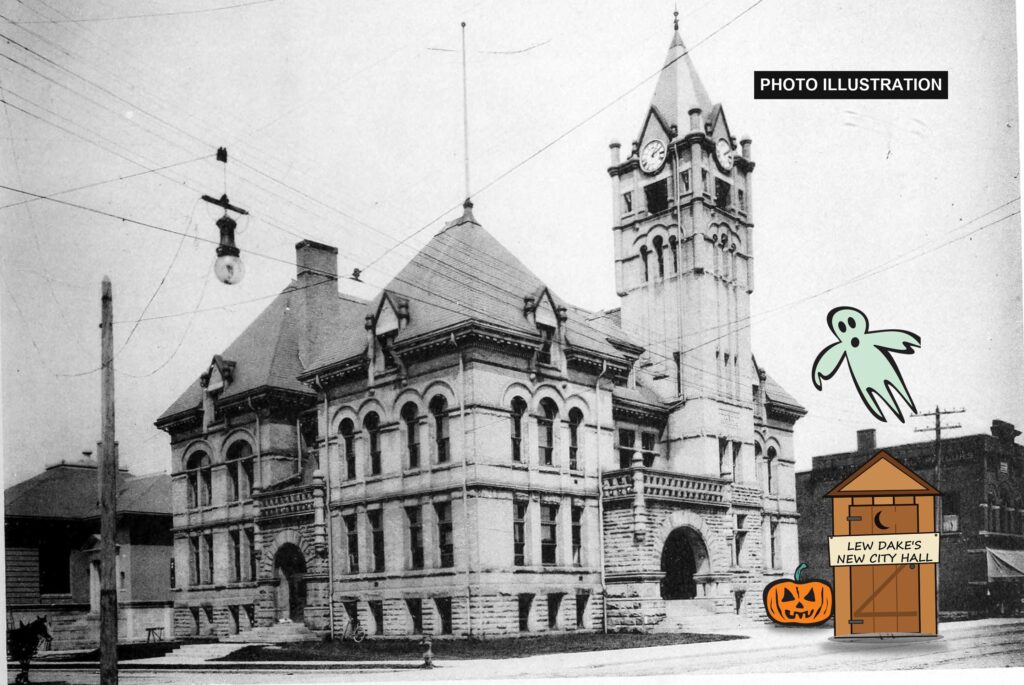
Photo illustration by LocVox: a cartoon outhouse, ghost and jack-o’-lantern added to a 1906 photo of City Hall, for the Halloween prank in this story. Photo: Souvenir of St. Thomas, Ontario, Canada, 1906. Queen’s University Library. Public domain. Ghost and jack-o’-lantern clipart © Corel Corporation, used under licence.
One Halloween night, some west-enders in St. Thomas got hold of an old outhouse, put it on a corner lot on Talbot Street and added a sign: “Lew Dake’s New City Hall.” City Hall stands on that corner today. The prank is told in a 1914 book of local history, St. Thomas and Its Men of Affairs. Newspapers of the day tell the rest. They show that the corner was not council’s first choice.
St. Thomas had wanted a new city hall for years. In 1895, ratepayers, the property owners who voted on city borrowing, turned down a by-law to build one. Then came 1897, the year of Queen Victoria’s Diamond Jubilee. At a meeting to plan the celebrations, two speakers called the old hall “a disgrace to the city.”
In May 1897, council set out to pick a site. Its twelve aldermen, the elected council members, were split down the middle as to where to build: six from the east-end wards and six from the west. At a meeting on May 11th, the mayor, Fred Wright, had to break the tie on nearly every vote. First, Patrick Meehan, an east-end alderman, moved to buy the corner where City Hall stands now. Only four of twelve aldermen voted for it. Next, the west end tried for the Molsons Bank lot, at Talbot and Hincks streets. Wright’s vote turned that down. Then came the Ellison lot, one block east of the bank, at Talbot and Southwick. The six east-end aldermen voted yes and the six west-enders voted no. Wright broke the tie in its favour, saying he believed it “the most suitable and the cheapest.”
The ratepayers would get to vote on a by-law to borrow $45,000 to buy the Ellison lot and build the hall, but before that, council had to give the by-law a first reading. This formal step needed enough aldermen in the room to make the vote official. So the next night, it was reported six west-end aldermen reached for their hats, “arose and bolted… In such a hurry were they to get out that one of them left his walking stick behind.” The clerk ruled, at the time, that council could not do business without them. The west-enders stayed away from the next meeting too. Then the city’s lawyer, who had given the same opinion, looked again and found that the mayor and six aldermen were enough. The by-law went ahead to a vote.
The ratepayers voted on Monday, June 14th, 1897. The Ellison by-law lost, 546 to 519. The vote split the city the same way council had split: the three east-end wards voted for it, and the three west-end wards voted against.
Within two days, the people who had pushed the losing by-law were calling for a new one, this time on the corner Meehan had wanted. Outside council, the 1914 book says, the campaign for the corner was run by Lew Dake. He was not an alderman. He kept the Dake House hotel, opened campaign rooms there, made his clerk, Oscar Rymph, the movement’s secretary, and went around with a petition asking the city to buy the corner. It was known as the Moore property, at Talbot and George streets. George Street is today’s Mondamin Street. Its owner, William E. Idsardi, had been mayor in 1896. He was a land surveyor and engineer who had helped survey and build the Canada Southern Railway. The corner had been part of M. T. Moore’s tannery yard, where animal hides were made into leather. The tannery’s old vats, the big tanks the hides soaked in, were still there.
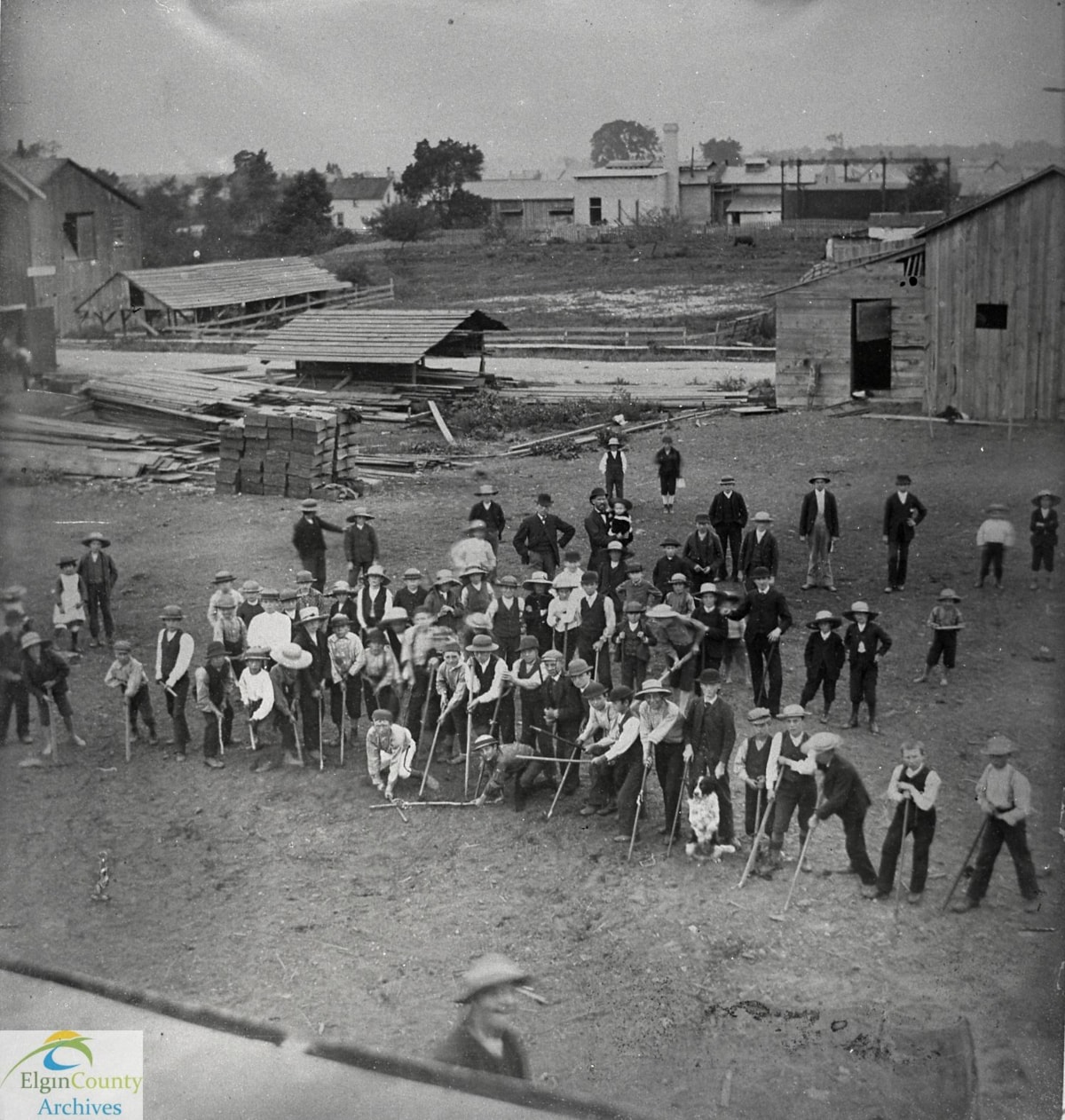
In September, council asked the ratepayers to vote on two by-laws on the same day, Monday, October 11th, 1897. One would borrow $40,000 to buy Idsardi’s corner and build a $30,000 city hall there. The other would borrow $10,000 to buy the Ellison lot and hold it as a city hall site “until the city is in a better financial position.” Each was its own yes-or-no question, and both passed. But the two lots were rivals, and only one would get the hall. Idsardi’s corner had the bigger win, 663 to 609. The Ellison lot passed by fewer votes. The Aylmer Sun, a weekly paper in nearby Aylmer, said council would now have to choose, unless the fight went to court.
The east end took the bigger win as its victory. To the east-enders, the 1914 book says, it meant City Hall was coming to their end of town, and the city’s business with it. The rain “came down in torrents” that night, but Lew Dake, “feeling and acting like a conqueror,” climbed onto the verandah roof of his own hotel to celebrate.
But the fight was not over. Council still had to give the by-law its third and final reading, the vote that would make it law. A court order stopped council from holding that vote. The book says west-enders brought the case. They had also been calling the lot “a bog hole where there was no proper foundation on which to erect a building.” The east end answered with clay. One cloudy midnight, Dake, Meehan and a few others took a dark lantern and an auger, a big hand drill, and, they claimed, bored down to clay. The next day Dake had a man dig a hole four feet square and put a sign over it: “This is the kind of ground we propose to build the city hall on. Ratepayers come and see for yourselves.”
The next night was Halloween. West-enders got hold of an outhouse “which had seen long service,” put it over Dake’s hole and added their own sign reading, “Lew Dake’s New City Hall.” The next morning the outhouse was taken away and the east end’s sign went back up. After that, a guard watched the sign and the hole every night. The book gives no year and tells these scenes before the vote, but the Halloween that fits best is 1897’s, about three weeks after it.
By November 11th, the court order had been lifted. Council then held its final vote, and that same month the by-law for a $30,000 city hall on Idsardi’s corner became law. In January 1898, a writer in the Daily Times, another St. Thomas paper, regretted that “such a splendid and beautiful site as the Ellison property was allowed to be passed by.”
With the site settled, the city needed a design. In February 1898, Meehan told council, “We don’t know what kind of a hall we want,” and asked for competing plans. The prizes were $150 and $75, and the whole building could cost no more than $32,000. About fifty architects “in all parts of America” asked for details, from as far away as Los Angeles and Halifax. The winner was Neil Darrach, a self-taught St. Thomas architect who started out as a carpenter and contractor. The cornerstone was laid in August 1898. The building opened in November 1899. It became a National Historic Site of Canada in 1984.
City Hall still serves the city at Talbot and Mondamin streets, on the old tannery corner the west end once called a bog. Darrach’s surviving buildings are the subject of “Neil R. Darrach: Built to Last,” an exhibition of photographs and artifacts that opened to the public at the Elgin County Museum on Monday, October 26th.
Sources: St. Thomas and Its Men of Affairs, 1914, pp. 66 to 69 (Elgin County Archives) · St. Thomas Evening Journal, January to March 1897 · April to June 1897 · St. Thomas Daily Times, November and December 1896 · December 1897 · January and February 1898 · March 1898 · Aylmer Sun, 1897 (Elgin County Archives) · Aylmer Express, October 14th, 1897 · Statutes of the Province of Ontario, 1877, chapter 87 · Sims, History of Elgin County, vol. 3, pp. 66, 77 and 95 · Souvenir of St. Thomas, Ontario, Canada, 1906 (Queen’s University Library) · Elgin County Archives: City Hall, St. Thomas, Ian D. Cameron Collection, D-2 · Elgin County Archives: Hook Check Game, St. Thomas, Ian D. Cameron Collection, L-3 · Elgin County: Neil R. Darrach, Built to Last, October 8th, 2026 · Parks Canada: St. Thomas City Hall National Historic Site of Canada
Facebook does not show posts that link to Canadian news sites, so this story is shared as a picture.
- Save the picture.
- Copy the caption.
- Start a Facebook post, add the picture and paste the caption.