

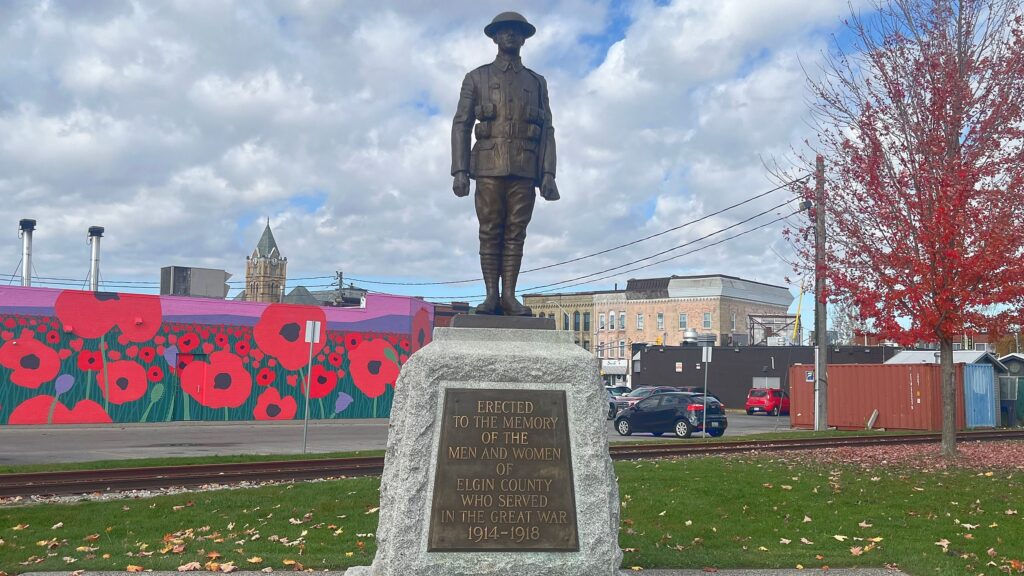
The Elgin County First World War Memorial in the Veterans Memorial Garden on Moore Street, St. Thomas, November 2026. City Hall’s clock tower is in the distance. The soldier statue came to St. Thomas in 1922. Behind it is the poppy mural “Heroes” by Andrew Lewis. Photo by Anthony Zruna.
On Thursday, November 7th, 1918, St. Thomas celebrated the end of the First World War. But the war had not ended. Late that morning, word reached the Times-Journal newspaper that Germany had signed the armistice, the agreement to stop the fighting. “The old city literally went mad, stark mad with uncontrolled joy!” the paper wrote. People poured in from the countryside. Mayor Edward A. Horton declared a half-holiday: the afternoon off.
An American news agency had sent the report out, but where it first came from is still unknown. About 3:30 that afternoon, an official telegram arrived denying it. The cheering faded, then started up again. The next day’s headline said everyone felt “That If It Isn’t True Now It Will be Soon.” All of this happened under a flu closing order. Since October 14th, the city’s Board of Health had shut theatres and banned church and school meetings to slow the 1918 influenza.
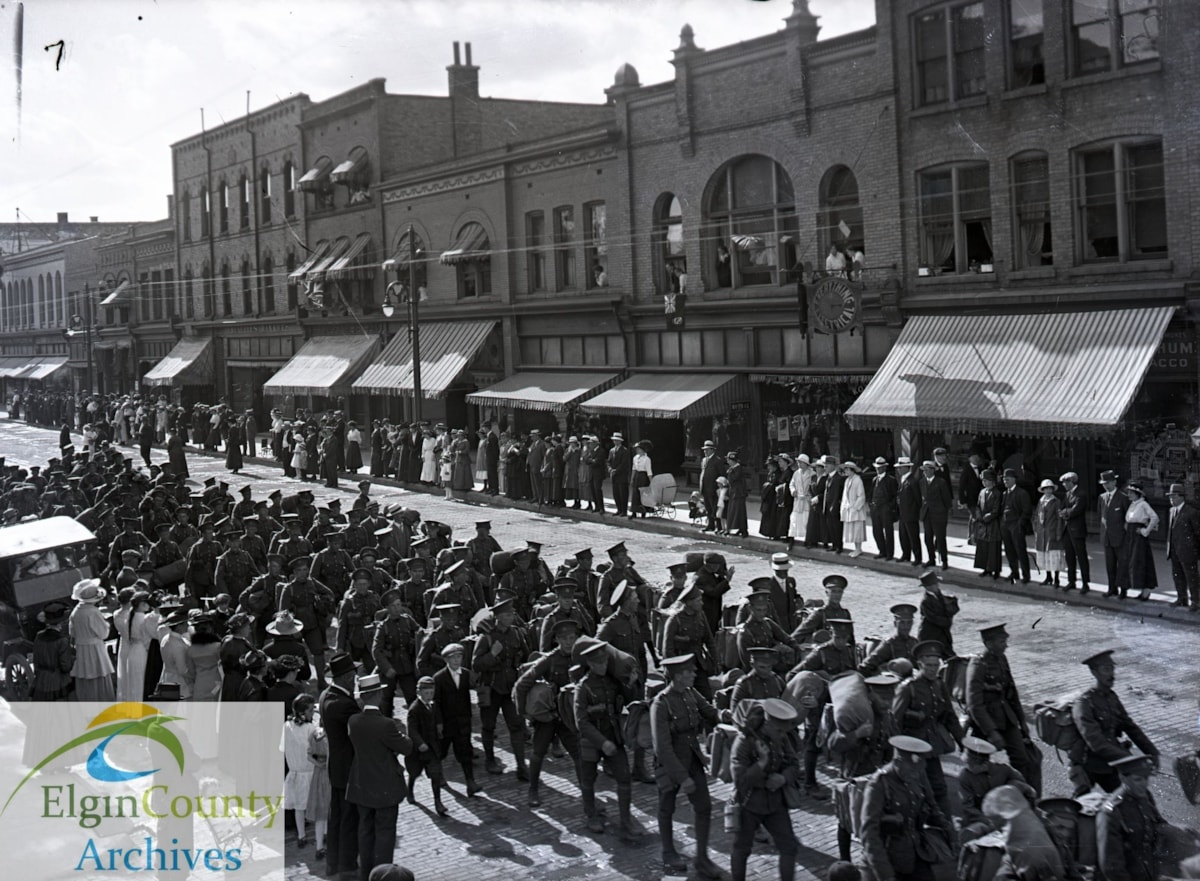
That Thursday evening brought a giant parade. Its main purpose was to sell Victory Bonds, loans to the government for the war, paid back with interest. But the paper said it became more than a bond drive: “a celebration of victory of the Allied arms.” It began at 7:30 at the Horton Market, which still runs on Manitoba Street today. Hundreds of soldiers home from the war marched, many missing an arm or a leg. A truck carried Billy, the goat from Pinafore Park, perched above a sign that read “We’ve Got the Kaiser’s Goat!” The Kaiser was Germany’s emperor, and the sign was a joke on the slang “to get someone’s goat,” meaning to make them angry. At the head of the parade, carrying a Canadian flag, walked Mayor Horton.
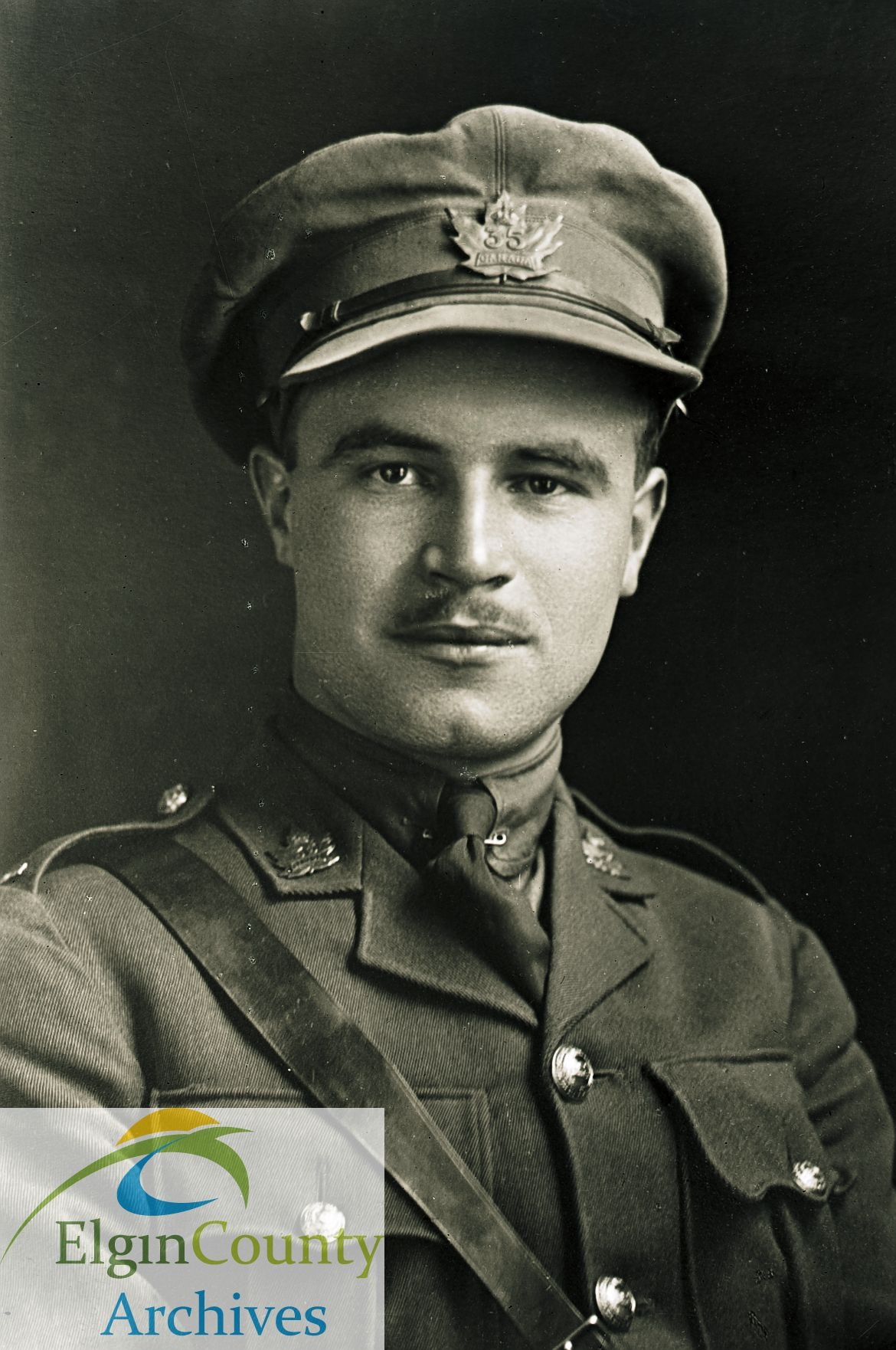
Five weeks earlier, the mayor had lost his eldest son. Lieutenant Andrew Allison Horton was 22. A London paper called him “one of the best puckchasers of the St. Thomas hockey team.” He went overseas as an officer of the 91st Battalion and from 1917 fought in France with the 1st Battalion. He was killed near Cambrai, in northern France, on October 1st. The news reached his father on the morning of October 9th, the paper reported, just as he was about to visit the city’s schools to talk about fire safety.
On the night of the parade, in front of City Hall, the mayor spoke of his son. The Times-Journal put the crowd at 25,000, more than the city’s whole population. With “tears in his eyes and a sob in his voice,” the paper said, he told them: “I thank God with all my heart that I had a boy who was big enough to fight for and die for the freedom that you are enjoying tonight!”
Rev. N. H. McGillivray, who was to preach at Andrew’s memorial service, spoke too. “Although the news of peace may be a little premature today,” he said, “it is nevertheless coming.” Then the mayor sent the crowd to the Michigan Central station to greet a train of American sailors on their way overseas. They were asleep in their bunks, and most had no idea peace was in the air. Told he was in St. Thomas, Ontario, one sailor shouted, “you folks act as if you were expecting us!”
The real armistice came four days later. On Sunday the flu order lifted, and churches reopened with services of thanks. It seemed, the paper said, “an accepted fact that peace would come in a few hours.” Word came over the Michigan Central’s telegraph wire from Toronto at 3:45 a.m. on Monday, November 11th. By 4 a.m. the city was “a veritable bedlam of noise.” “The hoax had been righted,” the paper wrote.
That afternoon, at a service in front of City Hall to thank God for the victory, Mayor Horton spoke again. “I know what sacrifice means,” he said. “All you have to do is to offer the best you have and you will know what sacrifice means.”
City Hall on Talbot Street, where both crowds gathered, still houses the city’s government. Andrew Horton is buried at Sancourt British Cemetery near Cambrai, and his name is on page 431 of Canada’s First World War Book of Remembrance.
Sources: St. Thomas Times-Journal, October 9th, 10th, 11th and 15th, 1918 (Elgin County Archives) · St. Thomas Times-Journal, November 7th, 8th, 11th and 12th, 1918 (Elgin County Archives) · London Advertiser, October 12th, 1918 · London Advertiser, November 8th, 1918 · London Advertiser, November 12th, 1918 · Toronto World, October 10th, 1918 · Aylmer Express, November 14th, 1918 · University of Toronto Roll of Service, 1914-1918 (1921) · Vernon’s St. Thomas Directory, 1919 · Canadian Virtual War Memorial: Lieutenant Andrew Allison Horton · The ABC of the Victory Loan, 1918 · Census of Canada, 1911 · Marvin L. Simner, End of the Great War in 1918 and its Impact on London, Ontario (Western University) · Sims, History of Elgin County, vol. 1, p. 209 · Sims, History of Elgin County, vol. 3, p. 106 · Veterans Affairs Canada: Elgin County First World War Memorial · Veterans Affairs Canada: Heroes mural
Facebook does not show posts that link to Canadian news sites, so this story is shared as a picture.
- Save the picture.
- Copy the caption.
- Start a Facebook post, add the picture and paste the caption.

Before you go
You read a local story to the end, so St. Thomas news matters to you. Once a week I gather the whole week into one Friday email: top stories, the weekend forecast, what council decided, what police logged, and what's on this weekend. Free, and one click unsubscribes you.
Send me Friday's newsletter