

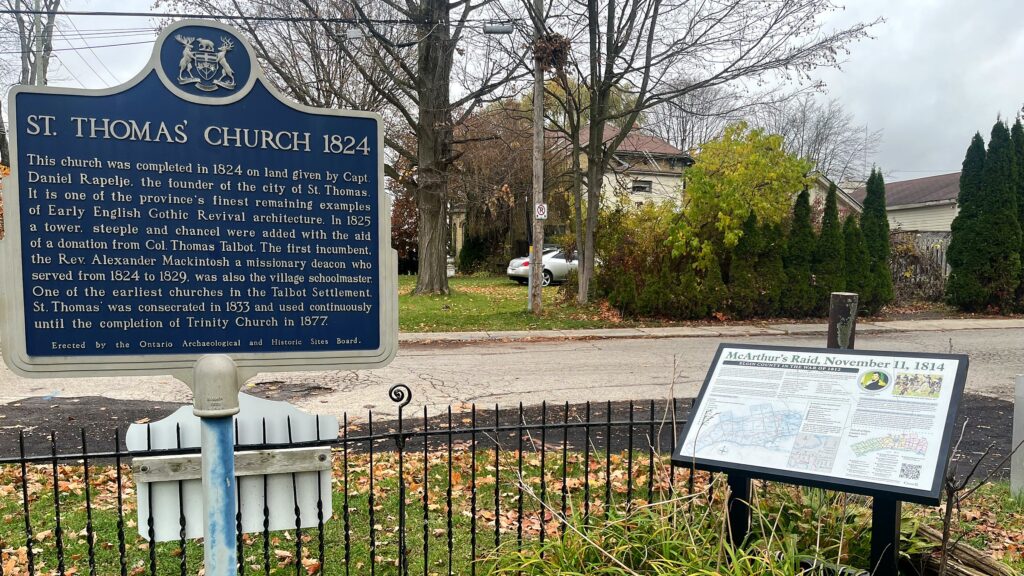
The McArthur's Raid marker (right) and the St. Thomas' Church 1824 plaque at Old St. Thomas Church, Walnut Street, in November 2026. Photo by Anthony Zruna.
Daniel Rapelje, a farmer at Kettle Creek, the settlement that grew into St. Thomas, counted his losses. After the War of 1812, settlers could file a losses claim, a signed list of what the enemy had taken or destroyed. Rapelje declared his losses came “when Plundered by a party of the Enemy Commanded by Genl. McArthur on the 11th Novr. 1814.” One line reads “45 Bushels Wheat Destroyd on the ground Where the Enemy encampt.” That ground is now the west end of downtown.
Rapelje had brought his wife and children to Kettle Creek in May 1810. He built a log cabin south of today’s Talbot Street. He served in the militia, the local farmers called out as part-time soldiers, and later became a captain. The year 1814 brought his family trouble twice. First, on September 9th, an enemy party under “a Captain McCormick” carried off the family’s clothing, bedding and furniture, even a pocketbook holding seventeen dollars.
The second came two months later. Duncan McArthur, an American general, had ridden out of Detroit in late October with, by his own count, “six hundred volunteers, fifty United States Rangers, and seventy Indians.” On November 6th, they fought the militia at Malcolm’s Mills, near today’s Oakland in Brant County, and burned mills the next day. On November 8th, McArthur turned for home along the Talbot Road, the road that runs through St. Thomas today as Talbot Street.
On November 11th, the riders reached the Rapelje farm. A family account, from one of the Rapelje children who saw it, says they came a little before sunset and found Daniel away. He had seen the raiders at Malcolm’s Mills, it says, but they reached Kettle Creek before him. They camped for the night in the wheat field. “At dark, the whole place was in a glow of light,” the account goes on. “The soldiers piled the fencing in heaps and set them on fire.”
Daniel’s son Jeronimus, about eight at the time, told his daughter in 1893 that the raiders “burned the rails, cut heads from the wheat and oats for their horses, and scattered the straw for bedding.” He also remembered: “McArthur’s body guard were Indians and they were the best dressed and finest looking men of the company.”
By morning, the family account says, “the sheep were all slaughtered” and the wheat and hay lay “scattered over the fields.” Besides the 45 bushels on the camp ground, the claim file lists 150 bushels of wheat in the sheaf, cut and bundled but not threshed. The list goes on: 80 bushels of corn, 40 of oats, 50 of potatoes, 12 tons of hay, 12 sheep and two hogs. Three hundred panels, or sections, of rail fence were burned. Two neighbours, William H. Lee and Thomas Curtis, certified “from our own Knowledge” that Daniel suffered the damage. George Lawrence, who farmed across the road, swore he knew the hay was there: it stood in “three Stacks which he helped to put up.”
The family also told a story about beehives. Colonel Thomas Talbot, who ran the settlement of this region, had left a box of valuable papers at the cabin, to be “kept safely at all hazards.” When American soldiers appeared on the hill across from the cabin, the story goes, Daniel’s wife set the box on the ground between some beehives. The bees guarded it, the family said, and the papers reached Talbot with nothing missing. Daniel’s claim lists two hives of bees among his November losses.
On November 18th, a week after the camp, McArthur reported that no more private property was destroyed than was “absolutely necessary for the support of the troops, for which regular payments or receipts were given.” Daniel declared he had “not received any remuneration whatever.”
The family put the raiders’ camp about where St. Andrew’s Market stood in their day, just south of Talbot Street between Stanley and William streets. The market moved away long ago. A short walk west, on the grounds of Old St. Thomas Church at 57 Walnut Street, an Elgin County Museum marker reads “McArthur’s Raid, November 11, 1814.” Daniel gave the land for that church in 1821, and he is buried in its churchyard.
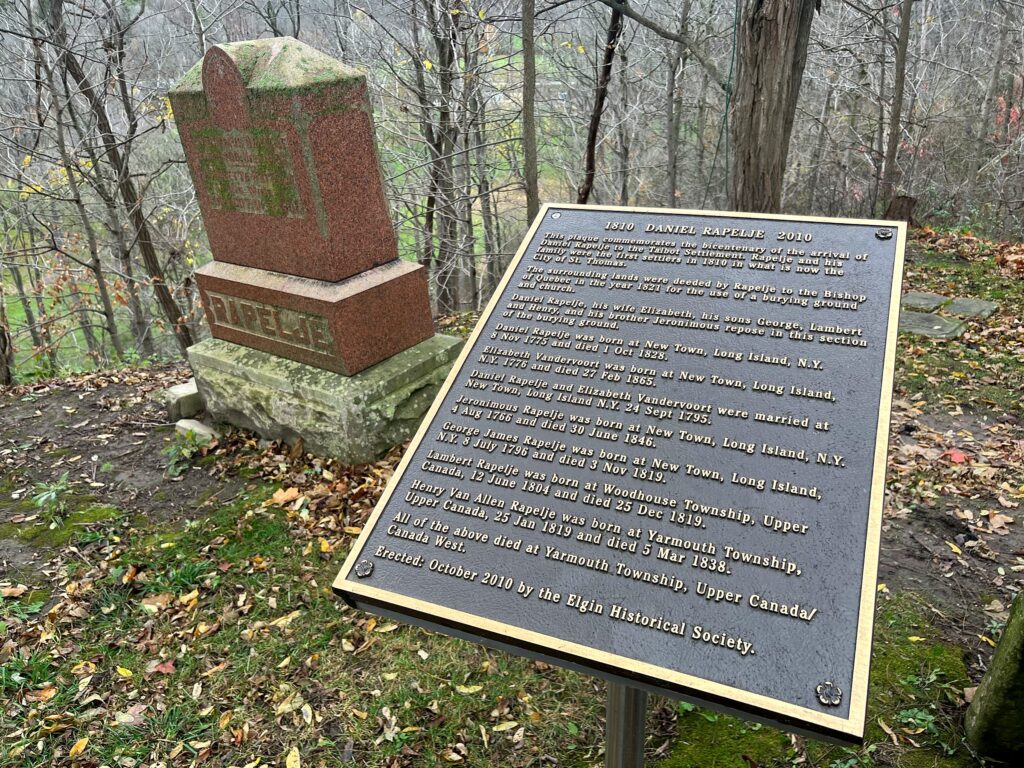
Sources: Daniel Rapelje’s War of 1812 losses claim No. 507, Library and Archives Canada (RG 19 E5(a), vol. 3747, microfilm T-1130) · Reminiscences of Early Settlers and Other Records, Elgin Historical and Scientific Institute, 1911: “The Rapelje Family” and “The Statement of Jeronimus Rapelje” (Elgin County Archives) · E. A. Cruikshank, The Documentary History of the Campaign upon the Niagara Frontier in the Year 1814, vol. II (McArthur’s report of November 18th, 1814) · Robert B. McAfee, History of the Late War in the Western Country (1816) · A. F. Butler, Historical Sketch of the County of Elgin (1877) · Sims, History of Elgin County, vol. 3, p. 106 · Colonel Talbot’s survey plan of Yarmouth, registered January 7th, 1814 (Archives of Ontario F 501-1-0-0-42, via Elgin County Archives) · Ontario Heritage Trust plaque, Captain Daniel Rapelje 1774-1828 · Elgin County Museum marker, McArthur’s Raid, November 11, 1814 · Plaque, St. Thomas Church 1824 · Relish Elgin, Spring 2012, War of 1812 feature (St. Thomas Public Library War of 1812 scrapbook, Elgin County Archives)
Facebook does not show posts that link to Canadian news sites, so this story is shared as a picture.
- Save the picture.
- Copy the caption.
- Start a Facebook post, add the picture and paste the caption.

Before you go
You read a local story to the end, so St. Thomas news matters to you. Once a week I gather the whole week into one Friday email: top stories, the weekend forecast, what council decided, what police logged, and what's on this weekend. Free, and one click unsubscribes you.
Send me Friday's newsletter