

The City of St. Thomas is planning what a big piece of downtown and the old railway lands will look like over the next 25 years, and residents get their first in-person look at the ideas tomorrow, Wednesday, August 26.
The project is called Railway City Central, or RCC 2051. It covers about 85 hectares (210 acres) through the middle of the city, and the easiest way to picture it is as one wide east-west band centred on Talbot Street and the old rail yards. The band stretches from Princess Avenue in the west to Alexandria Avenue in the east. Its north edge follows Kains Street and then Malakoff Street; its south edge follows Wellington Street. Inside it sit the central and east stretches of Talbot Street, the old CASO rail corridor, CASO Station itself, and the low-rise neighbourhoods on either side of the tracks.
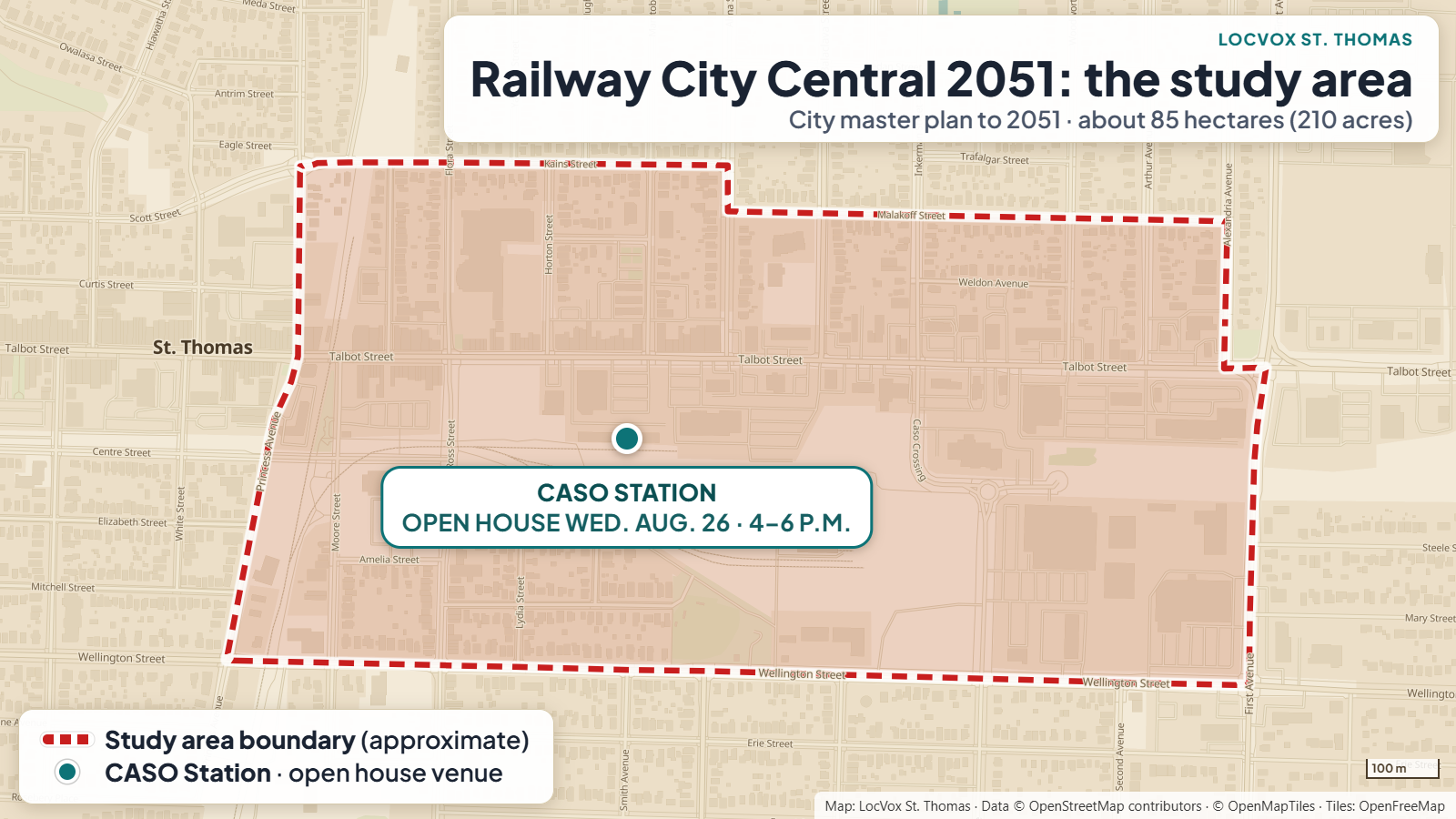
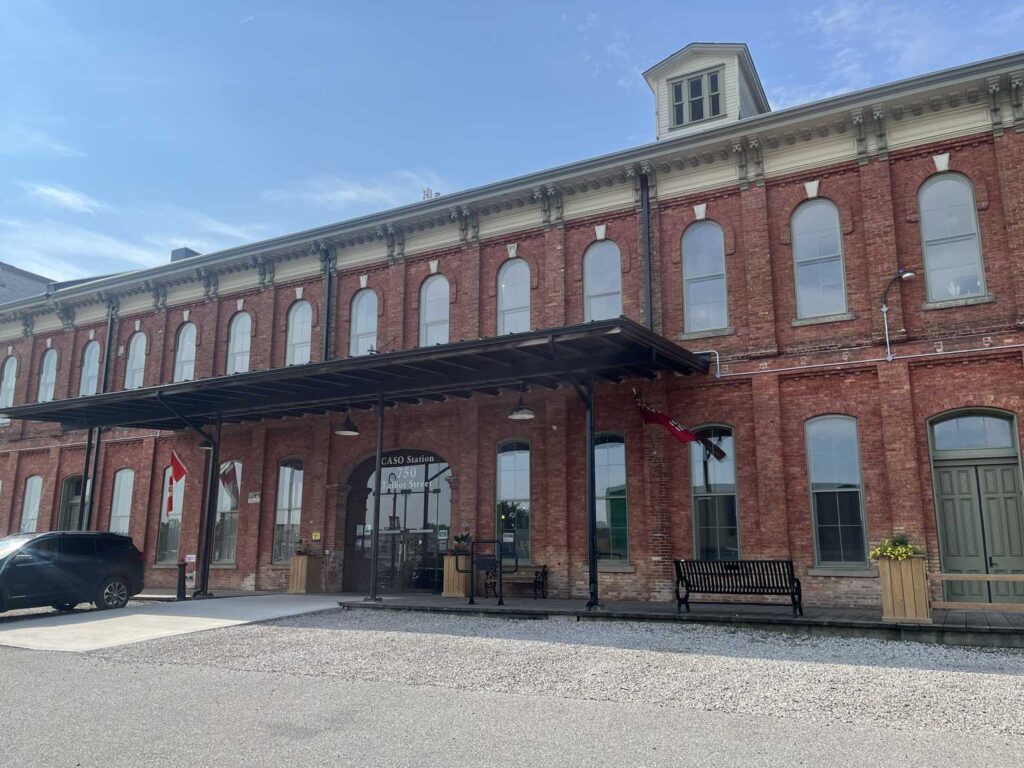
The first Public Information Centre runs Wednesday, August 26, from 4 to 6 p.m. as a drop-in open house, with a presentation at 5 p.m., at CASO Station’s Anderson Hall, 750 Talbot Street, parking available on site. Residents who cannot make it can still see the same materials and share their thoughts through the Speak Up St. Thomas project page, which already has a survey, an interactive pin map, and the draft Guiding Principles open for comment.
What the city already knows about the area
Planners spent the first phase of the project gathering facts about the study area. About 420 properties there have housing on them, with an average of 2.3 people per household. Roughly 180 businesses, not counting home-based ones, operate in the area, mostly in retail, food service, personal service, and professional or creative work. Almost two thirds of the land is residential, and about a quarter is commercial. Around 11 hectares, about 27 acres, sit vacant.
The area also carries real history. Seven properties are individually protected under the Ontario Heritage Act, and part of the study area falls inside the Downtown St. Thomas Heritage Conservation District. St. Thomas built its identity on rail lines: by 1914, eight different railways were running more than 100 trains a day through the city, earning it the nickname Railway Capital of Canada. CASO Station itself, built from 1871 to 1873, is a piece of that history, restored and now run as an event venue by the North America Railway Hall of Fame. The Elgin County Railway Museum, also inside the study area, has been closed since January for roof and window repairs, with no reopening date announced yet.
Why the city is planning ahead
St. Thomas is growing. Citywide, planners expect the population and number of jobs to grow by about 2 percent a year, adding roughly 15,300 households between 2021 and 2051. To keep up, the city estimates it needs about 7,700 new housing units between 2024 and 2034. A bigger share of that growth is expected to be apartments and townhomes than in the past, though just over half of all new housing is still forecast to be low-density. The city’s own growth study says that shift is driven largely by an aging population, and to a lesser degree by rising local housing prices.
The Railway City Central plan is meant to figure out how much of that growth this particular area can take on, and what it should look like, before decisions get made. The downtown stretch of Talbot Street already allows a mix of shops, offices, and homes under the city’s current planning rules. Whether that changes, and where, is part of what this study will help decide.
The city is also looking at what could happen with the old rail corridor itself. Planning materials for the area point to ideas like turning stretches of unused rail land into walking and biking trails, similar to how the Elevated Park already reused an old rail trestle at the city’s west end. Nothing here is decided. These are ideas the city is exploring for public feedback, not a finished plan.
What happens next
Phase 2 of the project, developing actual concept plans for the area, is underway now. City staff expect to post those concept options in early September for public feedback. After that comes a preferred plan, then the formal step of updating the city’s Official Plan and zoning rules to match. The city lists two staff contacts for questions: Michelle Knieriem, Manager of Planning Services, and Brandon Sloan, the city’s Housing Accelerator Fund (HAF) Coordinator.
Sources: Railway City Central 2051, Speak Up St. Thomas, Phase 1: Context Summary Document (PDF)
By Anthony Zruna · About the LocVox Newsroom