

St. Thomas council has voted to formally give up on a long-running plan to link the city’s stretch of historic rail line to Canadian National’s network, and to send what is left of the project’s money back to city reserves. The vote came at its meeting on Tuesday, September 8th, and the official minutes record the motion as carried.
The line in question is the old London and Port Stanley Railway, one of the first railways built in Ontario, with construction starting in 1853. The first passenger train reached Port Stanley in 1856, and the line carried riders until passenger service ended in 1957. The St. Thomas to Port Stanley stretch fell into disrepair and was abandoned in 1982 after a washout. Volunteers stepped in, rebuilt the track, and by 1987 had a provincial charter to run trains again. That heritage line is Port Stanley Terminal Rail, the tourist train that runs from Port Stanley’s station to St. Thomas. Most regular rides turn around well short of that, at Whytes Park; only a handful of summer trains and special charters cover the whole route.
What never came back was the connection between that line and CN’s national rail network inside St. Thomas. City staff say the question resurfaced in 2023, when a council inquiry asked whether rebuilding the connection could be coordinated with construction of the YWCA’s Project Tiny Hope tiny-home community, which was starting nearby at the time. Looking into it now, staff found the file goes back much further, and nowhere good.
Between 2016 and 2020, the city held detailed talks with CN about restoring the old crossing. CN said no. The city then explored routing its tracks west instead, connecting through a switch inside CN’s own rail yard, but the yard sits on a continuous curve that would not fit a new connection to CN’s engineering standards, and the city and CN could not agree on using land in the southern part of CN’s yard either. A short truck-to-rail transfer option came up in discussions too, but it was never pursued as a real substitute for a direct connection. CN’s position has not changed since, the staff report says, despite continued advocacy from Elgin-St. Thomas-London South MP Andrew Lawton.
The city won federal Canada 150 funding in 2017 to help pay for the reconnection. Once it became clear the project would not proceed, that money was redirected to rail-trail walking and cycling paths, and all of it has since been spent. What remains is about $285,000 from a separate city levy, tied up because the project itself was never formally closed out. Council voted to cancel the project and return that money to the city’s infrastructure reserve.
The city keeps the land and the rail materials it already owns, which are being stored at a cost of about $1,200 a year, rather than selling them off, in case a connection ever becomes possible later. Council also directed Parks and Recreation to report back on what could go on the land itself, something the city can weigh in a future budget. The report is explicit that no permanent buildings should go up there, since those would rule out reconnecting the rail corridor for good. One idea on staff’s own list of options, not a recommendation, is a small parkette or a rail-themed public feature that would leave the corridor open.
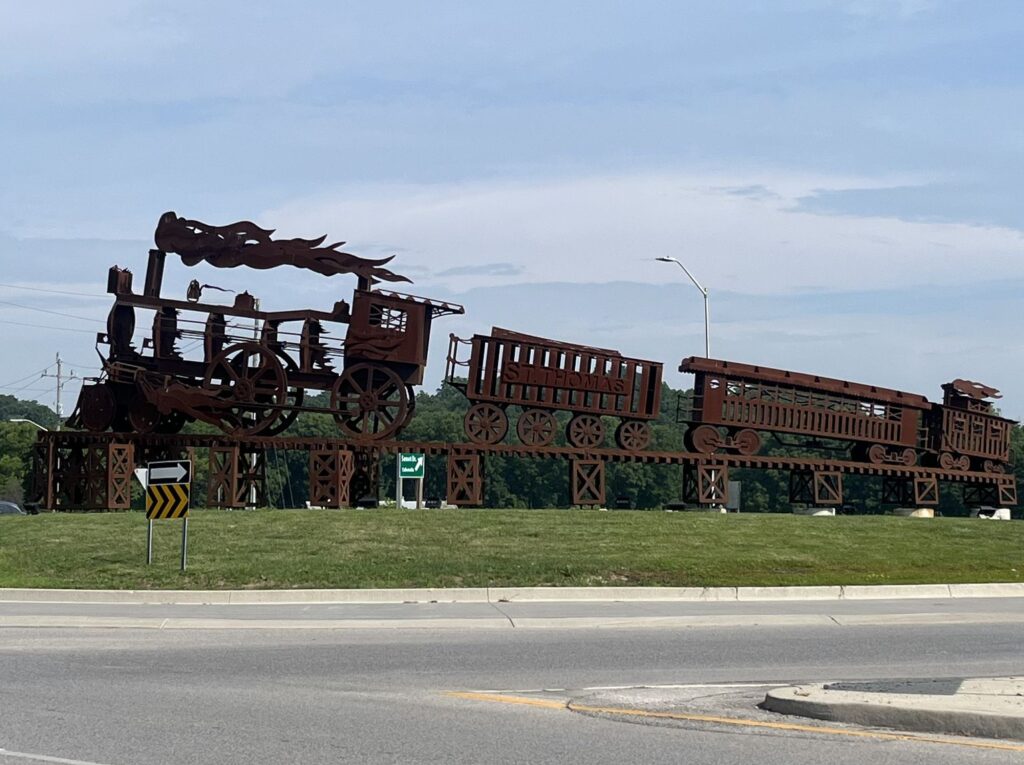
It is a quiet moment for a city that built its whole identity on railways. St. Thomas calls itself the Railway City, a name stamped on everything from its transit buses to the gateway signs at the city’s edges; by 1914, eight different railways ran more than 100 trains a day through three stations here. Even if this old link gets shelved, brand-new track is taking shape across town. A rail facility under construction inside the Yarmouth Yards industrial park, built to serve the new PowerCo Volkswagen battery plant, is expected to become the longest rail facility in St. Thomas once finished, rivalling CN’s own yard in London.
The debate before the vote is on the recorded meeting video. Before the vote, the city manager told council the motion cancels the 2016 budget project as it sits on the city’s books, not the goal of reconnecting: the city keeps the land, puts nothing permanent on it, and keeps pressing CN, which the mayor said he would continue to do alongside the local MP. One councillor asked whether the decision should wait until spring, worried about the message it would send to CN while the heritage railway’s supporters pursue a formal appeal, but no deferral motion was made and the original motion carried. The $285,000 now heads back to city reserves, and Parks and Recreation will report back on ideas for the land near Project Tiny Hope, the same tiny-home community whose 2023 construction first brought this old rail question back to the table.
Sources: St. Thomas council agenda, September 8, 2026 (Report CMO-57-26), St. Thomas council minutes, September 8, 2026 (item 15.d), Port Stanley Terminal Rail
By Anthony Zruna · About the LocVox Newsroom
Update - September 11, 2026, 6:31 a.m. ET: Added that council approved the staff recommendation at its September 8th meeting, with a summary of the debate, per the recorded meeting video. The official minutes have not yet been posted.
Update - September 14, 2026, 3:10 p.m. ET: The official minutes of the September 8th meeting have since been posted and confirm the vote. The headline and body now state council’s decision rather than the staff recommendation it adopted: the project is cancelled, the roughly $285,000 returns to the infrastructure reserve, the city keeps the land, and Parks and Recreation will report back on a passive use for it. The minutes are added to the sources.