

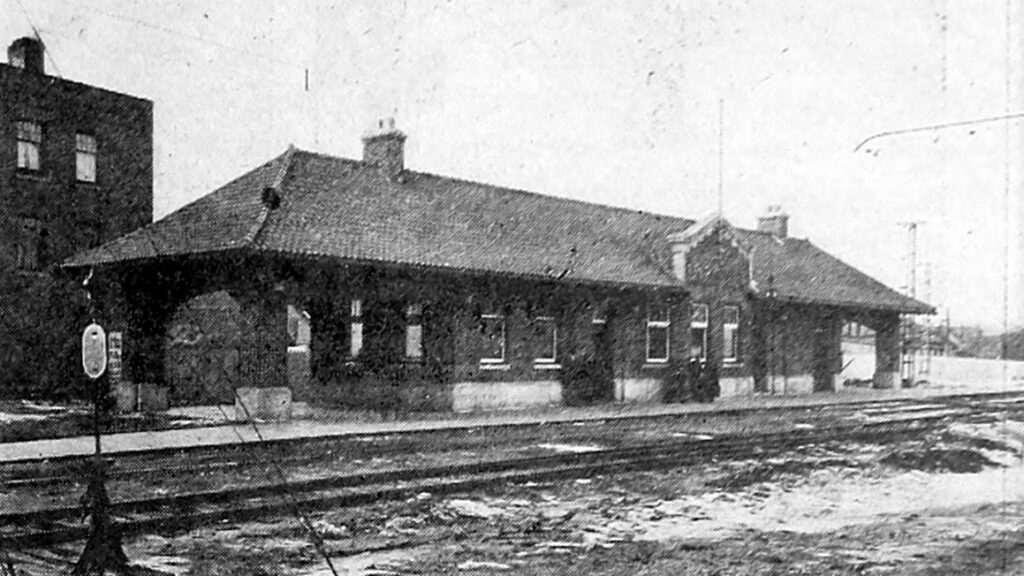
The London and Port Stanley Railway’s new St. Thomas station of the electric era, as pictured in May 1920. Photo from Electric Railway Journal, May 22nd, 1920. Public domain.
When A. F. Butler, who wrote the county’s history for its 1877 atlas, took his first ride on the London and Port Stanley Railway, he had no trouble finding a seat. These were “the dull times that followed the financial crisis of 1857-8,” he wrote, and “traffic was not brisk.” His only fellow passengers were Samuel Price of Port Stanley and H. C. R. Becher of London. Some twenty years later, he would be writing about summer crowds.
The London and Port Stanley was the first railway to reach St. Thomas, built from 1854 to 1856, when, as Sims’ History of Elgin County puts it, “railway fever had seized the country.” London businessmen and politicians pushed for it after the Great Western Railway reached their city in 1853, wanting a way south to Lake Erie. According to Port Stanley Terminal Rail’s history, its 23 miles were “entirely constructed by hand labour.”
Its birthday depends on who you ask. Port Stanley Terminal Rail says the first train reached the port on July 5th, 1856. The St. Thomas Public Library has the directors riding from London to St. Thomas in an hour three days later, and an official opening on October 28th. CASO Station’s railway hall of fame says September 25th. Butler said 1857. Whatever the date, Port Stanley Terminal Rail and the library agree that trains were running that July.
In town, the trains stopped at St. Thomas’s first station. Sims places it on Princess Avenue, then called Railway Street, across from the church building that is now the Princess Avenue Playhouse, with a water tank that a windmill filled from a deep well.
The line did not pay as its backers hoped. London, the counties of Middlesex and Elgin, and St. Thomas all put in public money, and Elgin County’s stock, Butler wrote, “proved a small elephant, bought for $80,000 and sold in 1872 for $5,000.” The library’s local history sheet adds a sting for this town: once the trains ran, St. Thomas merchants lost customers to London. From 1874 it was leased to one railway company after another.
Still, Butler saw the quiet line find its crowd. By 1877 he counted “six trains per day,” with summer passenger traffic, “chiefly excursion parties to the picnic grounds on Port Stanley Heights,” that was “very considerable.” His verdict: “It was never a great road but often a great convenience.” London took the line back in 1913 and rebuilt it under Sir Adam Beck, and electric trains ran from July 1st, 1915. Port Stanley Terminal Rail counts more than 28 million riders from 1915 to 1957.
At the lake, the railway ran the fun too: a bath house, a cafeteria, an amusement park and the L&PS Pavilion, a dance hall that opened in 1926 and was later known as the Stork Club. According to Sims, an arsonist set fire to the club on January 13th, 1979. The damaged building, Sims adds, was sold to an Aylmer livestock dealer, taken apart and moved to be rebuilt as an arena for livestock sales. The name lives on in the Stork Lounge, part of a brewery and restaurant finished in 2024 inside Port Stanley’s old Dominion of Canada customs building, a different building from the old dance hall.
The trains had been losing riders to the car long before the fire. Passenger service ended in February 1957, the last L&PS freight ran at the end of 1965, and in 1966 the line went to Canadian National. After a 1982 washout at Union, the St. Thomas to Port Stanley section was abandoned. Volunteers formed Port Stanley Terminal Rail and had tourist trains running again in 1983.
On September 8th, 2026, city council cancelled its project to reconnect the city’s own stretch of the old line to CN, keeping the land and saying it would keep pressing CN. But the Port Stanley end still runs. Excursion trains leave 309 Bridge Street on track that reaches the St. Thomas city boundary near Parkside Collegiate, though most trips turn at Whytes Park. It is part of the same line where Butler once had no trouble finding a seat.