

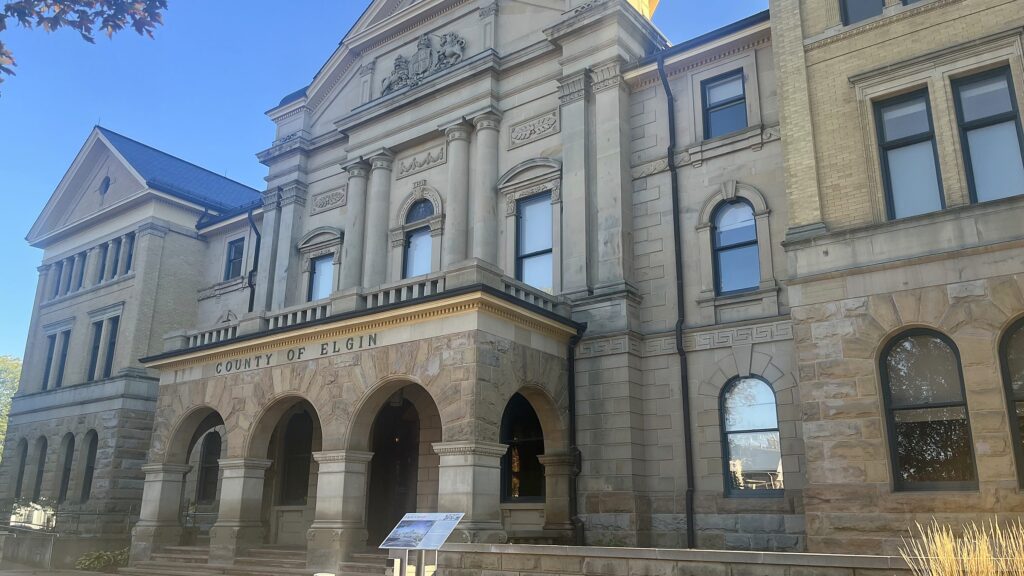
The front of the Elgin County Courthouse on Wellington Street in St. Thomas, October 2026. Photo by Anthony Zruna.
On July 13th, 1852, hundreds of people gathered in St. Thomas to watch the cornerstone of a new courthouse being laid. Under the stone went a glass jar. The Canadian Free Press reported that it held a list of dates, the population of each township, the names of local officials, several newspapers and some coins. When a jar was found in that cornerstone during renovations in 2012 it was empty. We will come back to that jar. First, the building, because St. Thomas had to fight for it and then pay dearly for it.
In 1846 the townships along Lake Erie were the south end of a large district run from London. People here said the district was too big to manage and that “everything was done to benefit London and its immediate neighborhood.” On August 27th, 1846, the St. George’s band made a circuit of Yarmouth Township through Sparta and New Sarum and was back in St. Thomas at noon for a public meeting. It was held on the balcony of the Mansion House hotel, under flags and banners. The meeting voted, with no one against, to ask for a district of its own. Benjamin Drake, who owned land in the middle of town, offered some of it free for a courthouse and jail.
Only parliament could grant the request, and for years it would not. John McKay, one of the leaders of the campaign, counted the tries for the crowd at the cornerstone ceremony. A petition with 3,000 names went to parliament in 1847. A second followed in 1849. A third was defeated in 1850. The fourth succeeded. By McKay’s count, the fight had taken six years.
In August 1851 a new law created the County of Elgin, named for the Governor General, the Earl of Elgin. It came with a catch. Elgin would keep sharing its local government and courts with Middlesex until a courthouse and jail stood finished in the county town. In 1852 that town was named: St. Thomas.
Then came the building, on the land Drake had offered. It did not go smoothly, and the Elgin County Archives tells the story. Garner Elwood took the contract in June 1852 for 4,580 pounds. The next month the county warden, Elisha Ganson, who headed the council, resigned in a dispute over the spending. The jail failed its inspection and had to be rebuilt. Elwood gave up the job in March 1853, and day labourers did most of what was left. The final bill was 11,405 pounds, about two and a half times the contract.
Elgin became a county of its own before the building was done. On September 30th, 1853, the official notice was published ending the shared arrangement with Middlesex. Elgin’s first regular county council met in the new county buildings that November 8th, though the courthouse itself was not quite finished. Court sat in the town hall that month and first sat in the courthouse on January 5th, 1854.
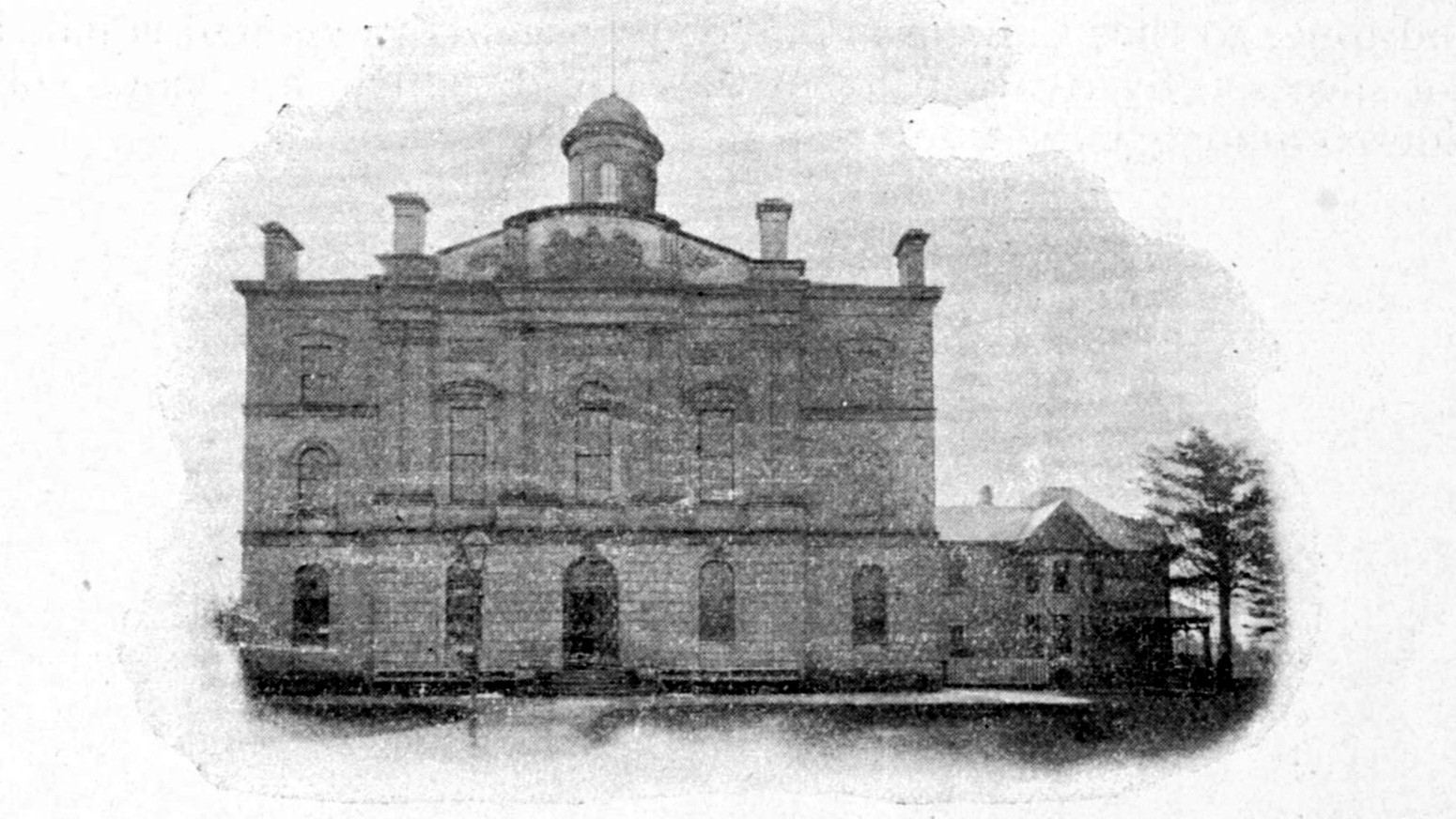
Fire struck on July 1st, 1898. It destroyed the roof and the upper part of the building, but the stone front survived. The courthouse was rebuilt larger around the old front, with a new wing on each side. It reopened on December 13th, 1899.
So what about the jar? The Archives says the empty one carries the name of a French prune maker, and research suggests it dates from about 1880, not 1852. Was the first jar taken out and replaced after the fire? The Archives asks that question too, and answers honestly: “Will the truth ever be known? It’s hard to know.”
Today the Elgin County Courthouse at 4 Wellington Street is still a working courthouse, restored and reopened on March 18th, 2014, when a new stainless steel time capsule went into the old cornerstone, to be opened in 2102. Walk up to the front doors today. The stone porch with its arches was added after the fire, and so were the wings on either side. Behind the porch, between the wings, is the old front that survived the fire. Above its centre window, the date 1853 is carved in the stone.
Sources: Elgin County Archives: Elgin County Courthouse virtual exhibit · Elgin County Archives: Time Capsule 1852 · Historical Sketches of the County of Elgin (1895) · C. O. Ermatinger, The Talbot Regime (1904) · A. F. Butler, Historical Sketch of the County of Elgin (1877) · K. W. McKay, The Court Houses of a Century (1901) · Courthouse historical marker (1853) · Courthouse historical marker (1898) · Infrastructure Ontario: The Elgin County Courthouse, a St. Thomas Landmark (March 18, 2014) · Infrastructure Ontario: Time Capsule to be Opened in 2102 · Ontario court locations: Elgin County Courthouse
Facebook does not show posts that link to Canadian news sites, so this story is shared as a picture.
- Save the picture.
- Copy the caption.
- Start a Facebook post, add the picture and paste the caption.

Before you go
You read a local story to the end, so St. Thomas news matters to you. Once a week I gather the whole week into one Friday email: top stories, the weekend forecast, what council decided, what police logged, and what's on this weekend. Free, and one click unsubscribes you.
Send me Friday's newsletter