

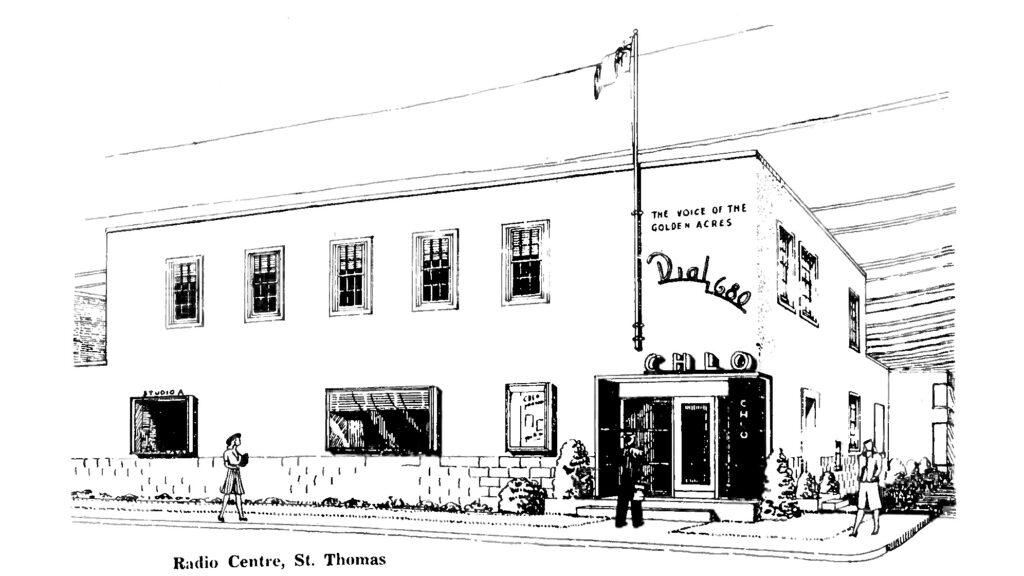
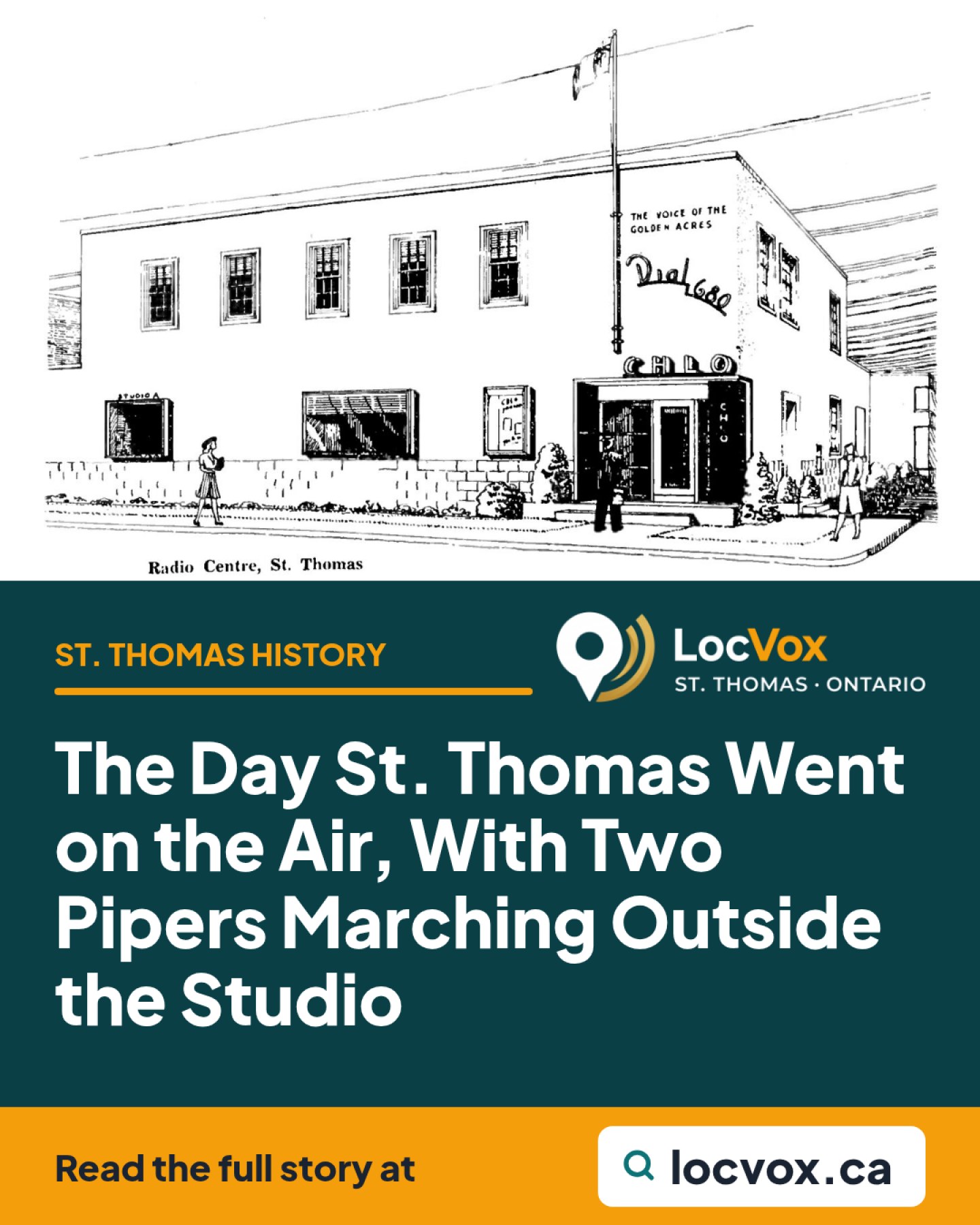
A drawing of Radio Centre, as the station called its studios in St. Thomas, from an advertisement CHLO ran in May 1948. Drawing from an advertisement for CHLO, Canadian Broadcaster, May 29th, 1948. Artist not named. Public domain in Canada.
St. Thomas did not need a radio station. That was the answer Jack Peterson got when he first applied for a licence to start one. It came from the Canadian Broadcasting Corporation, which in those years also had a say in who could have a licence for a private station. A survey done for the station before it went on the air found something different: about 70 per cent of 2,500 radio owners in the city kept their sets tuned to American stations.
Peterson was new to radio. He was a newspaperman who had joined the Stormont, Dundas and Glengarry Highlanders as an officer in 1940. He was wounded twice and was treated in London, Ontario, until November 1945. There he made up his mind to go into radio. He decided to try to open a station St. Thomas, where the Times-Journal reported that at least a dozen applicants had already been turned down.
It took him nearly two years of lobbying in Ottawa until the CBC would allow the station but only if its signal stayed out of the way of other stations, some as far off as San Francisco. Colonel B. deForest Bayly, a professor of radio engineering at the University of Toronto, took the job after other engineers said it could not be done. He had an answer within 10 days. The licence came in September 1947. Bayly’s answer took four towers, each 241 feet high, in farmland five miles northeast of the city. Forty-four miles of copper wire were plowed into the ground. “It makes you wonder why it is called wireless,” Bayly remarked.
For the studios, Peterson bought the old City Laundry building at Mondamin and Curtis streets as Talbot Street and anywhere south of it were ruled out as too noisy, due to the main street and the railways. Inside the old laundry, the builders made a room within a room. The studio floor rested on two inches of cork over new concrete. Even the windows were split, half for the inner room and half for the outer.
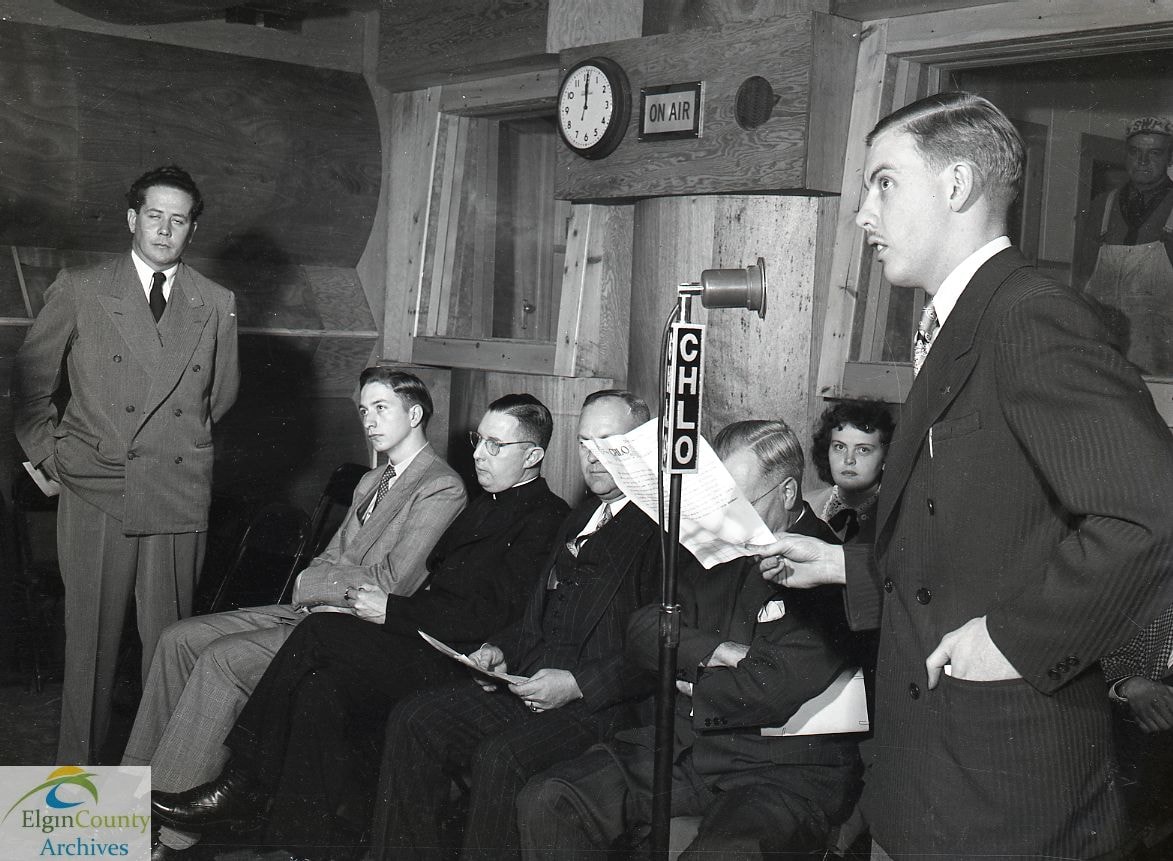
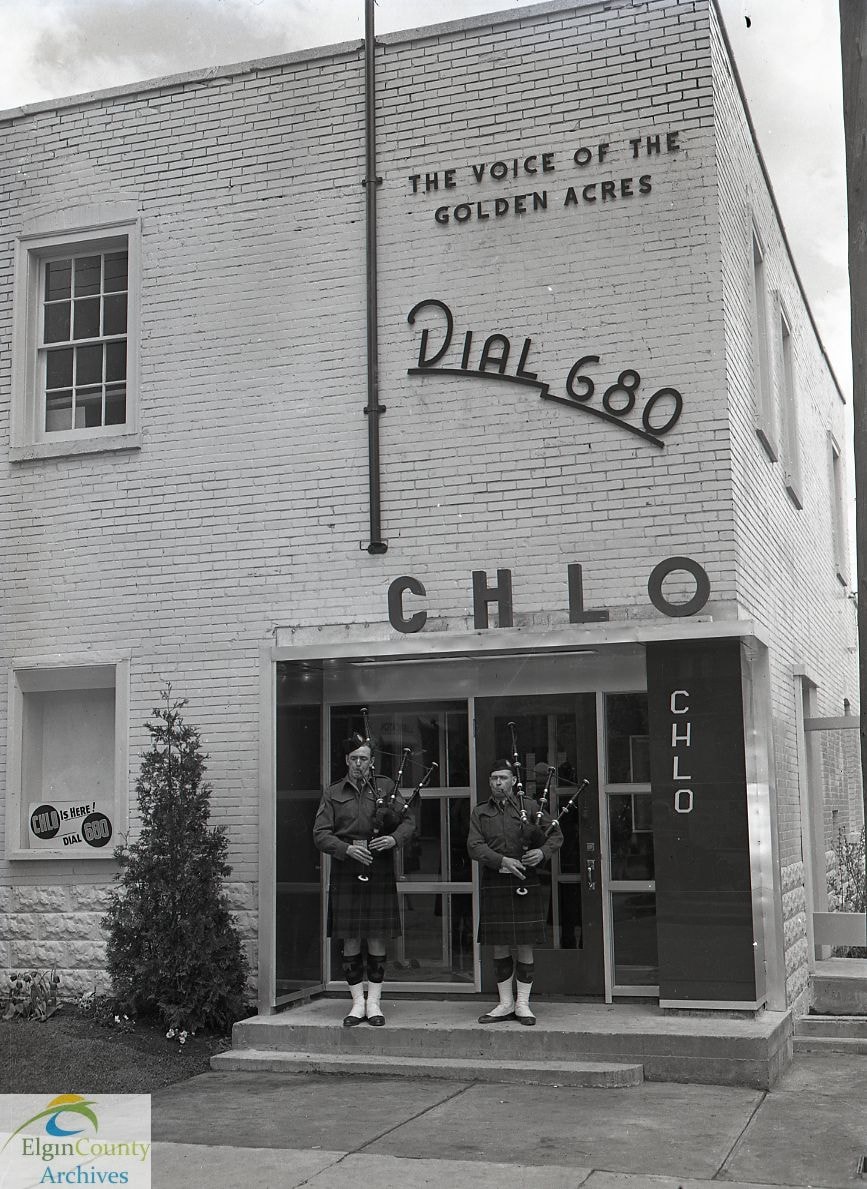
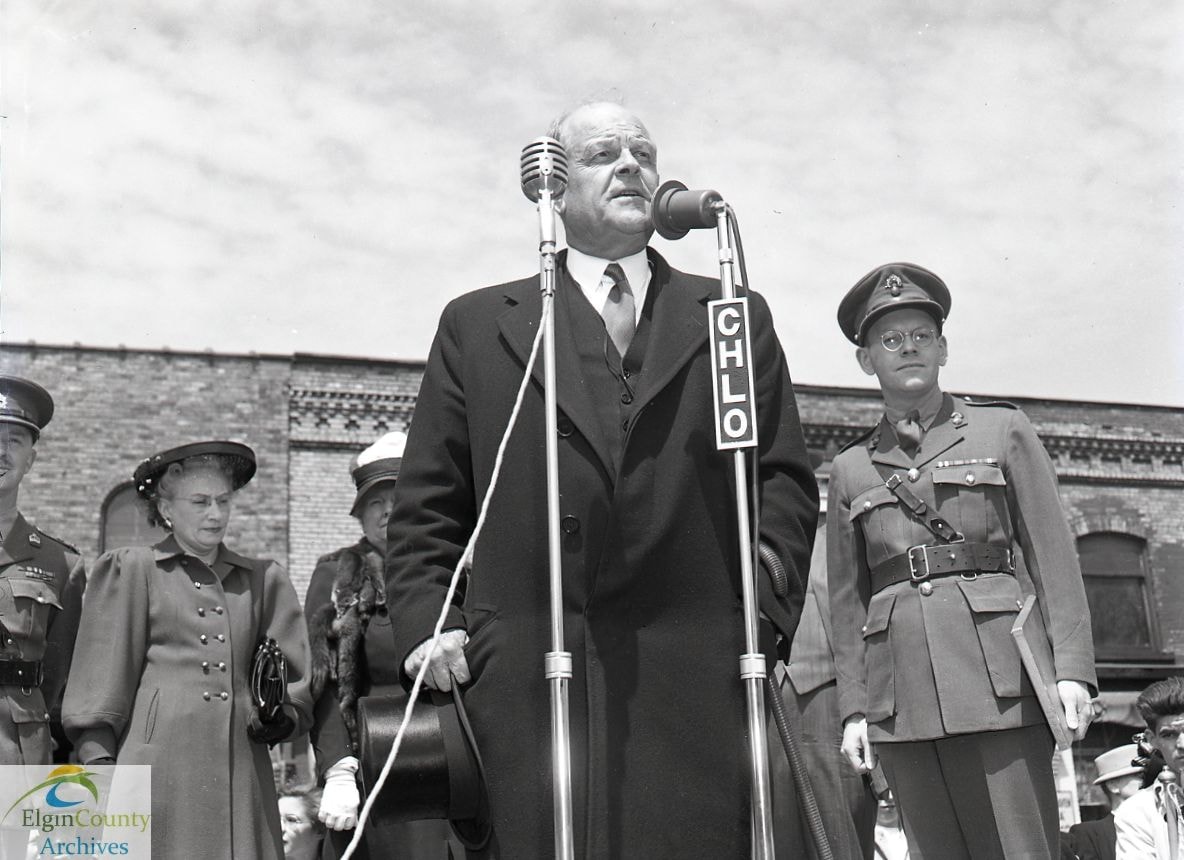
CHLO went on the air from that building at noon on Friday, May 14th, 1948. Mayor Bruce Caldwell gave the official welcome. Outside, two pipers from Peterson’s old regiment marched in front of the studios, piping the new station in by Scottish custom. At 1:30, Ray Lawson arrived at city hall. He was the Lieutenant-Governor of Ontario, the King’s representative in the province. At the Michigan Central Railroad’s park on Talbot Street he spoke to some 3,000 school children and gave them the rest of the day off school. That evening, at a dinner in the Grand Central Hotel, he declared the station officially open. The city that had been told it did not need a radio station now had one of its own.
The evening also helped another cause, money to build Memorial Arena. Two events that night were billed as salutes to CHLO, with the proceeds going to the arena fund. One was a Canadian Legion stage show at the Capitol Theatre. The other was a dance at the Port Stanley Ballroom, where the program called for four broadcasts. The dance netted $945.52. The arena’s own fund drive opened in June, with a goal of $200,000.

A two-storey building still stands at Mondamin and Curtis, across from the library, at the address the station kept until 1998. Signs for a health clinic and a day spa hang on it now. CHLO left the AM dial in 1994. Its FM successor moved its studios to London in 1998 and is 103.1 Fresh Radio today. The Memorial Arena still stands on Wilson Avenue, officially dedicated in 1954 to the veterans of the Second World War.
Sources: St. Thomas Times-Journal, May 5th to June 30th, 1948 (Elgin County Archives) · Canadian Broadcaster, May 1st, 1948 · Canadian Broadcaster, May 15th, 1948 · Canadian Broadcaster, May 29th, 1948 · Canadian Communications Foundation: CFHK-FM station history · Veterans Affairs Canada: Memorial Arena, St. Thomas · Gathering Our Heroes: Major Jack F. Peterson · Downtown St. Thomas business listings
Facebook does not show posts that link to Canadian news sites, so this story is shared as a picture.
- Save the picture.
- Copy the caption.
- Start a Facebook post, add the picture and paste the caption.