

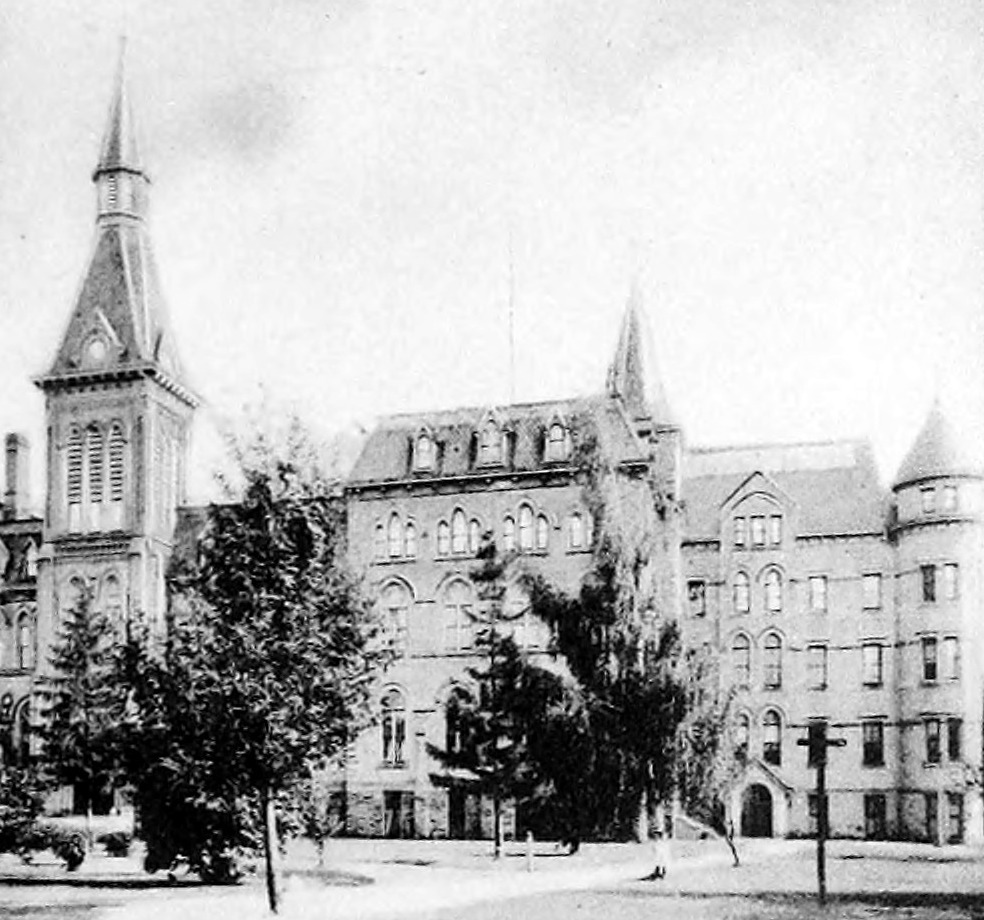
Alma College in St. Thomas, as pictured in a souvenir book of city photographs published in June 1906. Photo: Souvenir of St. Thomas, Ontario, Canada, 1906. Queen’s University Library. Public domain.
Alma College started with a visit and a request for money. In March 1876, Bishop Albert Carman came to St. Thomas to talk with local people about starting a college for young women here. His church was the Methodist Episcopal Church in Canada. Until 1875, he had run Albert College in Belleville. The town had about a month to decide whether to help pay for the new college.
His request reached town council on Tuesday evening, April 4th, asking for a grant of town money. Council passed it to a committee of citizens that included three county officials: the county judge, D. J. Hughes; the county sheriff, Colin Munro; and the county registrar, A. McLachlin. A week later, the local Canadian Home Journal said there was “no time to be lost.” Oshawa’s council, it noted, had just granted $3,000 to a similar school, which also got five acres of land. “Should this town do less than that?” the paper asked.
On Tuesday evening, April 11th, the committee invited more citizens to join. On Thursday evening, April 13th, eighteen men met in the courtroom, with Judge Hughes in the chair. He said the college would bring professors, teachers and students to town, and others who would settle here because of it. Nearly everyone favoured the offer. Part of the appeal was that, although a church would run the college, it would not teach any one church’s beliefs. It would be open to “the daughters of all our citizens,” whatever their race or religion.
During the courtroom meeting, Mayor Drake was asked to call an additional public meeting in the Town Hall. It met on Monday evening, April 17th. The first resolution said the town should meet Carman’s offer “with promptitude and liberality,” meaning quickly and generously. Only two people voted against it. The meeting’s final resolution, moved by Sheriff Munro, asked council to grant $5,000 of town money toward a college building costing at least $20,000.
Two days later, the church’s yearly Niagara Conference, meeting in Hamilton, backed the plan and named a board to run it. It set two conditions. The town council had to grant the $5,000, and enough people had to pledge money to justify going ahead.
The town’s newspapers of 1876 show no council vote on the money. On May 2nd, council named the mayor and five councillors to meet with the citizens’ committee. The college’s backers turned instead to the people of St. Thomas for pledges. By May 23rd they had about $1,800 promised, and by early July $3,260. Storekeeper James Carrie even advertised that he was so busy collecting pledges, he scarcely had time to tell shoppers about his new stock. In July, the church’s board set a new condition: the college would come once $5,000 had been pledged in St. Thomas. By April 1877, the church’s report listed all $5,000 as pledged.
For the rest of the money, the board hired an agent, John Cook. Starting in October 1876, he travelled from church to church across the region asking for pledges. By the spring of 1878, the church reported, he had raised about $14,000, counting “the sum given by the people of St. Thomas” but not the land.
With the money coming in, the plan moved ahead. Ontario’s law creating the college was approved on March 2nd, 1877. The law already used its name, Alma, which Sheriff Munro chose for his late wife and their daughter. The board paid $2,400 for land near the centre of town. It covered nearly six acres, with a ravine running through part of it. Architects sent twenty designs to the board’s contest. James Balfour of Hamilton won. Adam Crooks, Ontario’s Minister of Education, laid the cornerstone on May 24th, 1878, Queen Victoria’s birthday.
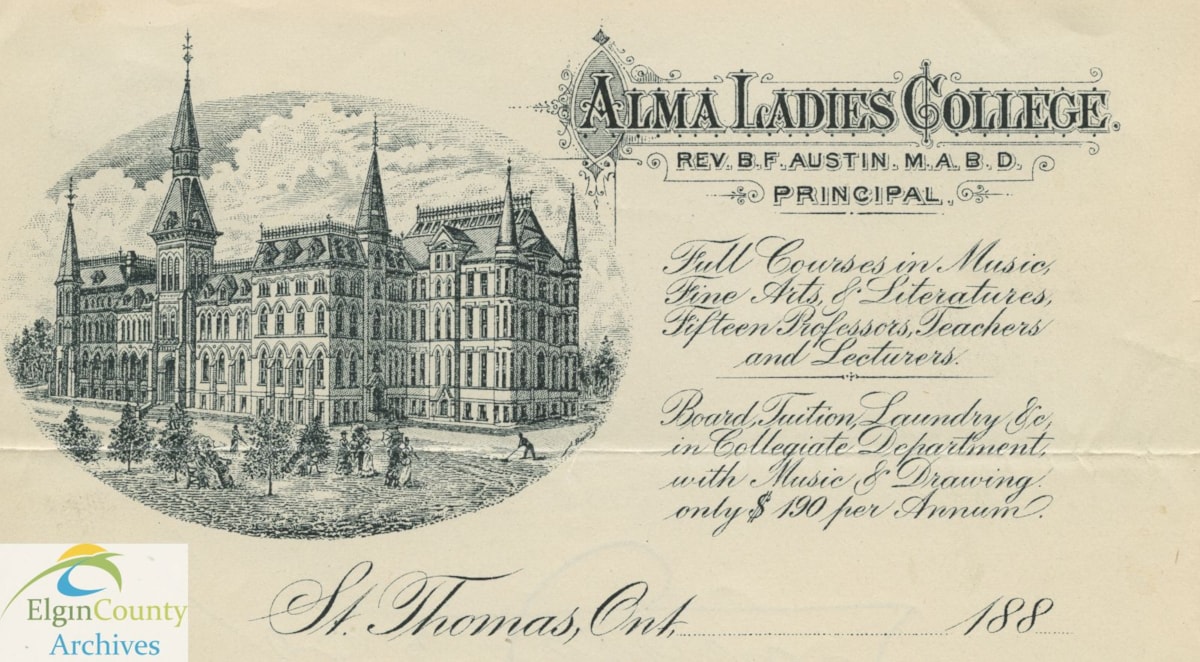
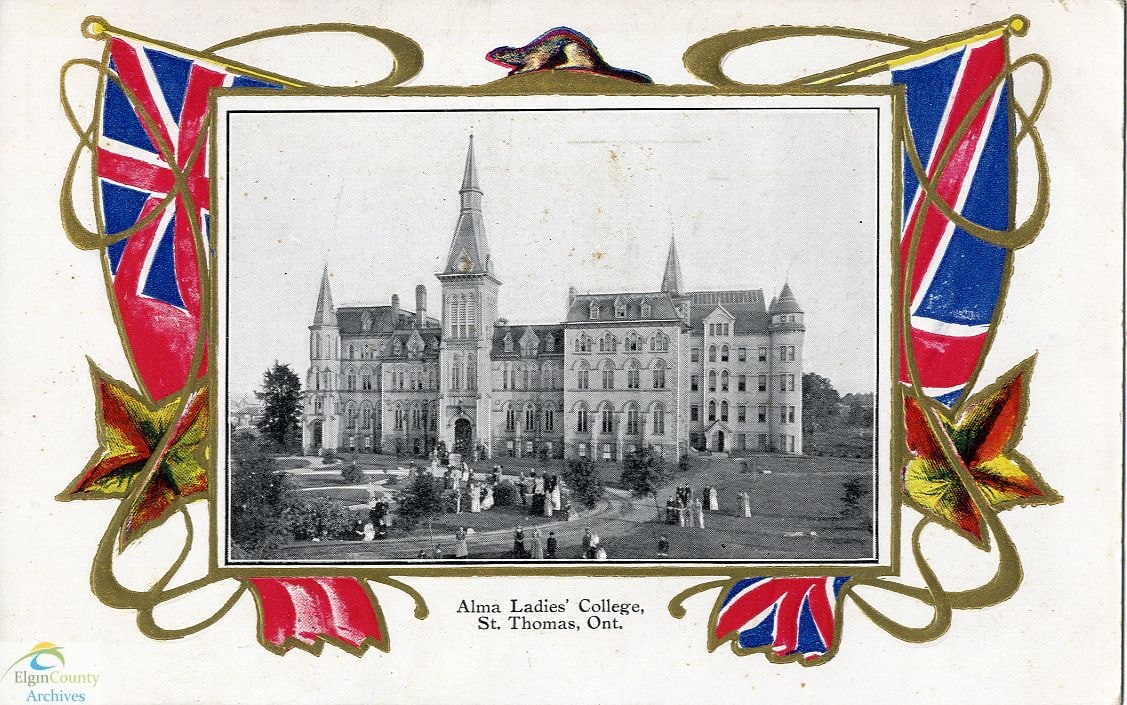
The finished main building was 150 feet long and 73 feet wide. Its tower and spire rose 136 feet above the grounds. Visitors came in through the tower. Alma College opened on October 13th, 1881, with Bishop Carman preaching the sermon. That night the building glowed with light inside and out, and the St. Thomas Journal said it “presented a magnificent appearance.” It started with 50 to 60 students. By the end of the first year 178 had enrolled.
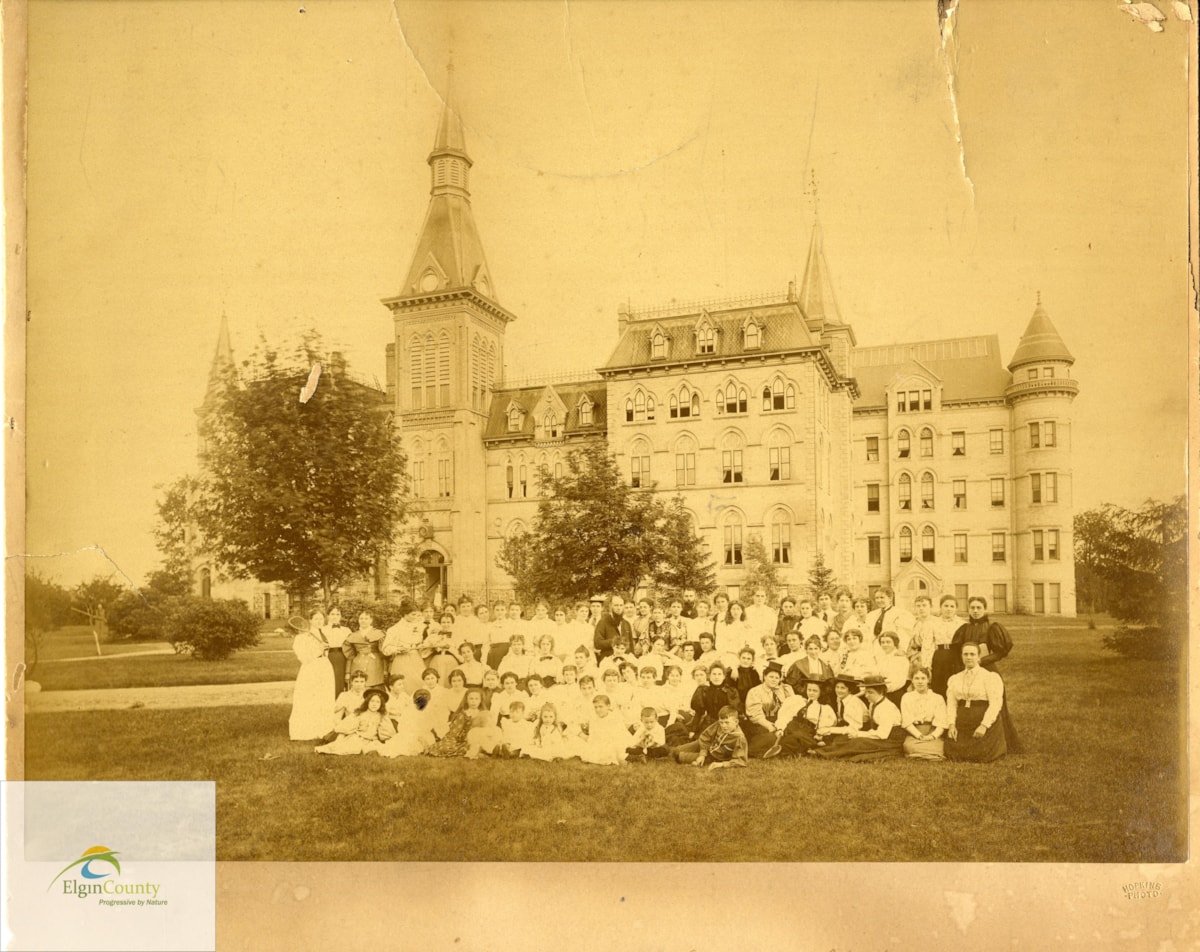
This year marks 150 years since the town said yes. The college closed in 1994, and fire destroyed the empty main building in 2008. Today the old college grounds on Moore Street are becoming Alma College Square, three apartment buildings that will stay rental. City council approved its subdivision plan on October 13th, 2026, 145 years to the day after the college opened.
Sources: St. Thomas Weekly Dispatch, March 23rd, March 30th, April 6th and June 15th, 1876 (Elgin County Archives) · Canadian Home Journal, April 11th, April 18th, May 5th, May 19th, May 23rd, June 9th, July 7th and October 3rd, 1876 (Elgin County Archives) · Minutes of the Methodist Episcopal Church conferences, 1876 · Minutes, 1877 · Minutes, 1878 · Statutes of the Province of Ontario, 1877, chapter 64 · Announcement of the Alma Ladies’ College, 1883/4 · Dictionary of Canadian Biography: Albert Carman · Alma College Centennial Book 1877-1977, Chapter One · Chapter Six · Elgin County Archives: Alma College fonds · Elgin County Archives: portrait of Mrs. J. C. Duffield · City of St. Thomas, Report PD-65-26 · City of St. Thomas, Keeping Track, Issue 53 · Ontario Heritage Trust: Alma College remembered (2008)
Facebook does not show posts that link to Canadian news sites, so this story is shared as a picture.
- Save the picture.
- Copy the caption.
- Start a Facebook post, add the picture and paste the caption.

Before you go
You read a local story to the end, so St. Thomas news matters to you. Once a week I gather the whole week into one Friday email: top stories, the weekend forecast, what council decided, what police logged, and what's on this weekend. Free, and one click unsubscribes you.
Send me Friday's newsletter