


St. Thomas police are asking families to take one more careful look through their Halloween candy. The St. Thomas Police Service is investigating after a person reported finding a piece of a razor blade inside a mini Mars bar they got while trick-or-treating in the courthouse area on Halloween evening.
The person told police they visited Centre Street and Margaret Street, but the exact address where the chocolate came from is not known. The bar and what police call the “reported blade” have been handed over to police for examination, and the investigation is ongoing. As of their release on Monday, November 2nd, police had received no other similar reports.
Police want parents and caregivers to check all Halloween candy before anyone eats it. If you find something suspicious, don’t eat it. Keep the candy and its packaging, and call the St. Thomas Police Service. Anyone with information about this case is also asked to contact police.
St. Thomas police also pointed to “similar reports in other communities.” This year, Durham police, east of Toronto, are investigating a report of sewing needles in Halloween candy. Toronto police are looking into one report, and so are Peel police, west of Toronto. Quebec provincial police are looking into two reports of needles and metal pins in chocolate. In LaSalle, near Windsor, police said a child was given a Tootsie Roll with a paperclip in it, and the child did not eat it.
How often does this happen? Nobody can say for sure, because nobody keeps a full count. Tampering with candy is usually charged as mischief, and no database of candy-tampering cases exists, CBC News reported in 2019. When CBC asked the RCMP and police in six big Canadian cities whether anyone had ever been charged with tampering with Halloween candy, none of them could say.
The counts that do exist each catch only part of the picture. The Canadian Food Inspection Agency told CBC it had known of only four reports of suspected Halloween candy tampering from April 2008 to October 2019, none of which resulted in an injury or a death. Joel Best, a University of Delaware professor whose tally of tampering stories goes back to 1958, counts only reports that reached major newspapers. He writes that most local reports “don’t appear in the tally.” His count for 2015 is three, for the United States and Canada combined. However, by November 4th that same year, Global News had counted eight in Ontario alone.
Best also lists five children’s deaths once blamed on poisoned Halloween treats, and none turned out to be a stranger’s doing. A Detroit boy in 1970 had found the heroin in a relative’s home, a Texas boy in 1974 was poisoned by his own father, and the other three died of illness or natural causes.
Reports like the one in St. Thomas come up around many Halloweens, and they don’t all end the same way. Some are hoaxes, and some may start at the factory. Some are traced back to a house, and some end without a public answer. Finding out how something got into a treat is hard. By the time it is found, the candy has gone from a factory to a store, to a home, to a trick-or-treater’s bag. Often, as in this case, nobody knows which house gave it out.
In some situations the reports fall apart. In Ottawa in 2016, police said a girl had put sewing needles in her own chocolate bars. In Cochrane in 2024, Ontario Provincial Police said a report of a blade in Halloween candy was unfounded.
Sometimes police raise the factory as a possibility. Last year in Regina, police got three reports of small pieces of metal stuck into chocolate bars, from different parts of the city. “It could potentially be something more like a manufacturing issue,” the acting police chief said. In Cambridge last year, Waterloo Regional Police said they had “not ruled out the possibility” that a small pin nail in a chocolate bar got there during manufacturing or packaging.
Things really do get into candy at the factory. Canada has recalled Skittles, Starburst and Life Savers gummies (2022) and Cadbury Wunderbar bars (2024) over pieces of metal, and KitKat Scary Friends mini-bars (2023) over pieces of rubber. The Canadian Food Inspection Agency says foreign objects in food, such as metal, glass and plastic, should be reported to it. You can report a food concern online with the brand and the UPC code from under the barcode, or call 1-800-442-2342.
Sometimes police do trace it to a house. On Halloween in 2019, police in Waterbury, Connecticut, said razor blades found in the candy bags of two trick-or-treaters came from the same home. They arrested a man on charges that included reckless endangerment and risk of injury to a minor. The blades were in the bags, not inside the candy. The man told police the blades had ended up in his candy bowl by accident, but police said he gave no explanation of how the blades were handed out to children with the candy.
And some cases end without a public answer. In Cambridge in 2017, a girl needed emergency surgery after eating a Reese’s Peanut Butter Cup with pieces of metal in it. Days later, police were still investigating where the metal came from, and LocVox found no later public report of what police found. In London in 2019, a teenage boy bit into a Mars bar from trick-or-treating in Wortley Village and found a razor. He was not hurt, and police said the exact place the chocolate came from was unknown.
None of that tells us what happened in this case. That is what the police examination is for.
Word of a scare can also travel faster than the facts. On Sunday morning, a public Facebook post said “many people” who walked the area around the courthouse were “reporting the same thing.” As of Monday afternoon, police said they had received no other similar reports. And a Halloween-night warning about glass in candy, shared more than 100 times in a St. Thomas Facebook group, was later corrected by the person who posted it: the glass had come from the pillowcase used to collect the treats.
For the rest of this year’s haul, Health Canada’s advice is simple: don’t let kids eat any treats until an adult has checked them, look for small holes in the wrappers, and “throw out anything that’s torn, unwrapped or in loose packaging.” The short version: “When in doubt, throw it out!” But if something looks tampered with, keep it and its wrapper and call police.
Sources: St. Thomas Police Service release, November 2nd, 2026 · Joel Best, “Halloween Sadism: The Evidence” · Health Canada, Halloween safety tips
By Anthony Zruna · About the LocVox Newsroom
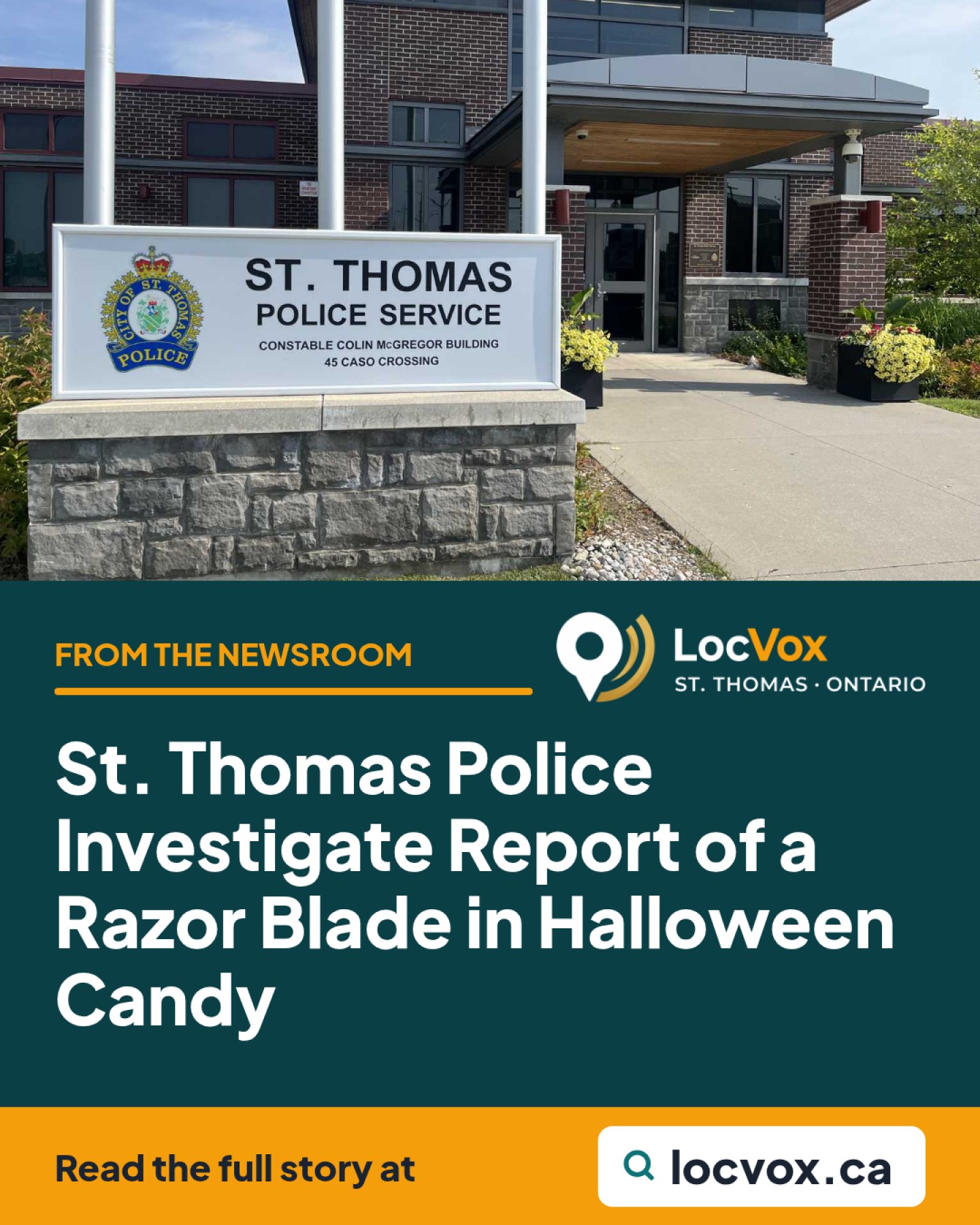
Facebook does not show posts that link to Canadian news sites, so this story is shared as a picture.
- Save the picture.
- Copy the caption.
- Start a Facebook post, add the picture and paste the caption.

Before you go
You read a local story to the end, so St. Thomas news matters to you. Once a week I gather the whole week into one Friday email: top stories, the weekend forecast, what council decided, what police logged, and what's on this weekend. Free, and one click unsubscribes you.
Send me Friday's newsletter