

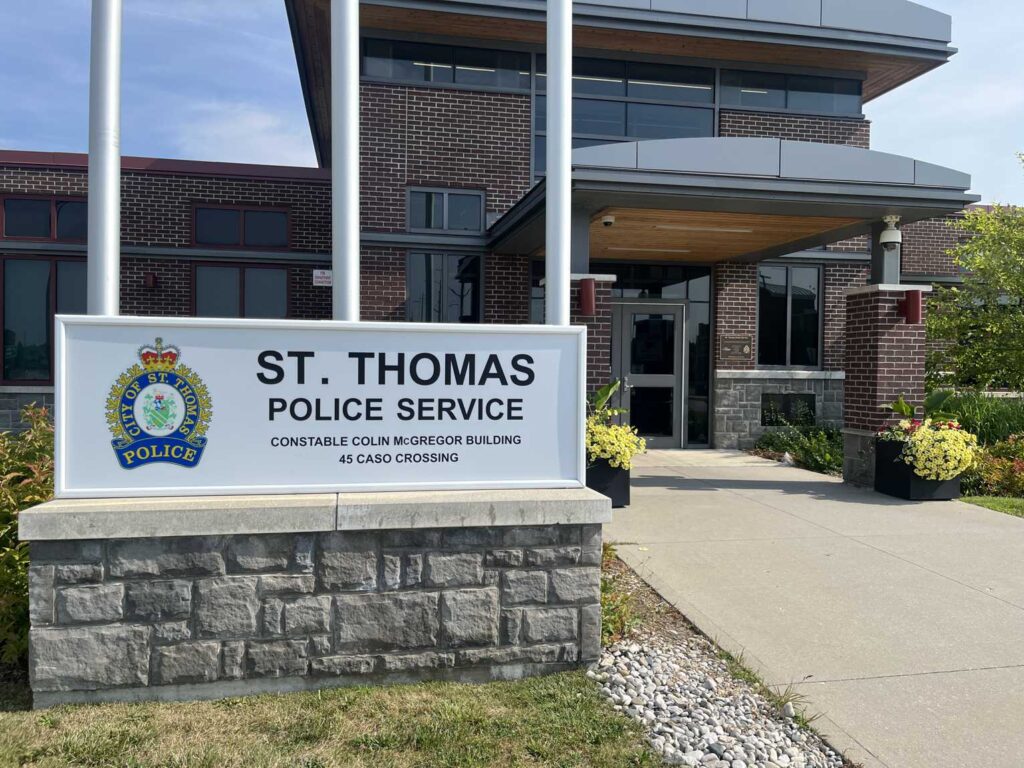
The St. Thomas Police Services Board wants $24,220,687.50 to run the police service in 2027. That is about $2.6 million more than this year, an increase of nearly 12 percent. The Board endorsed the number at its September 9th meeting and announced it publicly on September 15th. The request now goes to the City of St. Thomas. Council decides how much the city will fund in total, and the Board decides how that money is spent, line by line.
A significant piece of the increase is locked in before anyone debates it. Salaries and benefits make up more than 96 percent of the budget, and the collective agreements already guarantee officers a 4 percent wage increase in 2027, plus higher benefits, OMERS pension contributions, specialty pay and shift premiums. The 2027 ask also follows a much bigger jump: the 2026 police budget rose about 22 percent over 2025, from roughly $17.7 million to $21.6 million. The Service says that year’s catch-up spending on staffing, equipment and readiness is why this increase is smaller.
Three new positions are a smaller piece of the increased budget request: two Constables and one Financial Coordinator, together about $342,000, or 1.4 percent of the total ask. The Board says the two Constables will add front-line and investigative capacity and help keep 24-hour policing staffed. The Financial Coordinator is tied to a change at City Hall: the City plans to push more day-to-day financial work out to individual departments, and the Service says it needs someone of its own to handle budgeting, forecasting, purchasing, grants and audit readiness for a budget over $24 million.
Salary progression and staffing decisions already made account for most of the rest of the payroll increase. Outside payroll, goods and services climb about $447,000. Grants also cover less of the bill: net of the spending they pay for, grant money is down about $533,000 from this year. The Service calls that a prudent approach: three competitive provincial grants it applied for in 2026, together worth up to $1.1 million, are not counted until they are awarded, and any that come through would lower the final bill to the city. The ask is also already trimmed by $150,000 from the police development-charge reserve, covering growth costs such as a new patrol vehicle and equipment for the two new officers.
The Board points to real pressure behind the ask. As of August 2026, St. Thomas Police had logged more than 1,200 more occurrences than during the same stretch of 2025. In its own words, an increase like that “has never occurred in the history of the STPS in such a short period of time.” It adds strain across front-line response, investigations, disclosure, supervision and records processing.
Residents were asked too. Over four weeks in July and August, an STPS survey drew 439 responses from residents, business owners, students, parents and STPS members. Five priorities rose to the top for 2027 through 2031: drug activity, crime prevention, police visibility and community safety, emergency response, and violent crime, and 93 percent of respondents backed continued spending on proactive crime prevention, public education and outreach.
The Board is making the request while crime numbers are improving, and it says so itself. As LocVox has reported, the city’s Crime Severity Index is lower than it was three years ago: down 10.1 percent overall since 2023, with violent crime severity down 17.4 percent in 2025 alone after a sharp rise in 2024. For perspective, at 61.6 the city’s overall index still sits above Ontario’s 57.2 and well below the national figure of 75.0. St. Thomas has been above the provincial number since 2018, when a surge of drug-driven property crime pushed its index up 60 percent in a single year, and it has never returned to the levels of the mid-2010s, though on violent crime alone the city now scores below the province.
The Board also points to the downtown core: calls for service there are down 18 percent since 2020, complaints about drug use and related activity are down 84 percent since 2020, and calls involving unwanted persons are down 75 percent since 2021. Deployments of the tactical CIRT team, the kind LocVox described after the September 13th intimate partner violence arrest, still rose 94 percent in 2025, from 32 to 62. The calmer overall numbers do not mean less serious work.
Reith called the 2027 number a balance between two obligations. “The Board takes its responsibility for both public safety and financial oversight very seriously,” he said. “We believe this submission represents a responsible investment in maintaining front-line capacity, supporting our members and ensuring the Service remains prepared to meet both current and future public safety needs.”
By the Service’s own estimate, the 2027 budget works out to about $474.92 for every St. Thomas resident, up from $424 this year, when St. Thomas was the second-cheapest of ten Ontario police services it compared itself against. The Service says that still leaves it comparatively low-cost, with about 537 residents for every officer, one of the higher ratios in that group. None of this is final. The budget the Board endorsed now moves through the City’s own municipal budget process, where council weighs it against every other department’s request before settling the 2027 budget.
Sources: St. Thomas Police Services Board Approves 2027 Operating Budget (media release, St. Thomas Police Service, September 15, 2026); PSB Report CHIEF-2026-26, Operational Budget 2027 (Police Services Board Open Session meeting package, September 9, 2026); Crime Severity Index, police services in Ontario, Table 35-10-0188-01 (Statistics Canada, 2025 data released July 22, 2026)
By Anthony Zruna · About the LocVox Newsroom